What Flows and What Is Paid
Two peoples refuse to call the living a 'resource': the Aymara, according to Huanacuni, through ayni—the energy that circulates; the Kággaba, according to the OGT, through pagamento—the debt repaid to the earth.
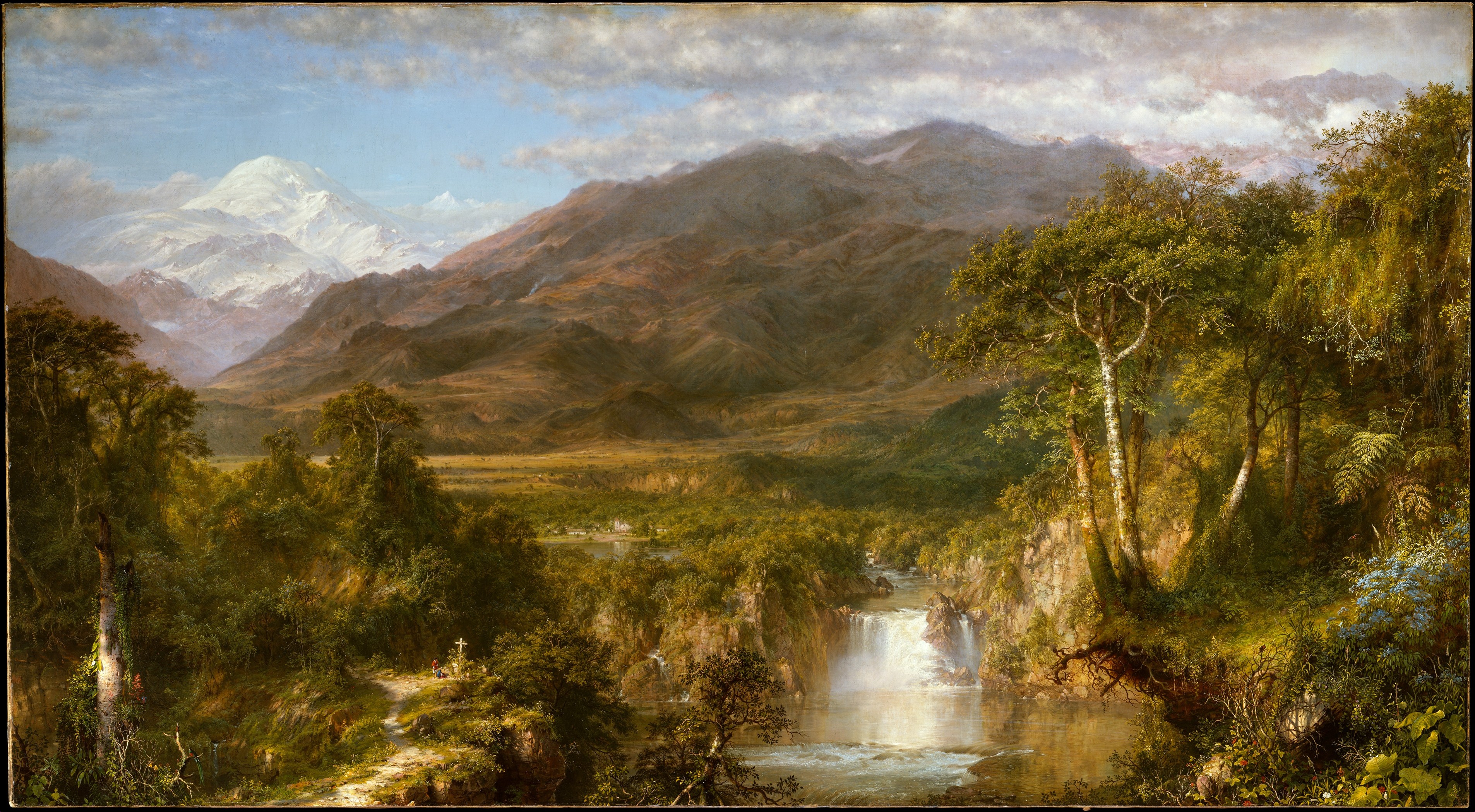
Open the earth like a drawer. That is what the word resource implies without saying so: something lying in wait, in reserve, for someone to come and take it. A resource is extracted the way one withdraws a sum from an account—the act owes nothing; it draws from a stock. The language of extraction is a one-way language: the hand enters, the hand leaves full, and nothing in its grammar requires a return.
Two peoples of South America, separated by thousands of kilometers and by all that divides a high plateau from a coastal massif, stumbled upon this language and rejected it. Not to replace it with sentiment—“love nature”—but with another form of accounting, where taking commits one to giving back. They both refuse it. They do not refuse it in the same way. And it is the gap between their two ways, more than their agreement, that has something to teach us.
The Energy That Circulates
Fernando Huanacuni Mamani is an Aymara jurist and writer from Bolivia. In 2010, he compiled the philosophy of vivir bien for the Coordinadora Andina de Organizaciones Indígenas in a book that has since become the reference. This is not “what the Aymara think”—no one speaks for an entire people; it is the synthesis of a named voice, carried by an accountable Andean organization. At its center, a word he presents almost as a dictionary definition:
Spanish Ayni, término aymara que significa “reciprocidad”, “la energía que fluye
entre todas las formas de existencia”.
English Ayni, an Aymara term meaning “reciprocity,” “the energy that circulates among all forms of existence.”
The decisive word is circulates. Ayni is not a barter, where two parties face each other and settle an exchange. It is a current in which one is already caught, and living consists of not interrupting it. The rain renews life for all, says Huanacuni; plants exhale oxygen for all beings; the sun warms for all. Each gives and receives in the same movement, without being able to say where the exchange begins or ends. In such a world, the word resource literally has no place:
In the ayllu, there is no room for the term “resource,” for if everything is alive, what exists are beings, not objects, and the human being is neither the sole measure of life nor the king of creation.
What strikes one in this reciprocity is that it needs no administrator. It is not a ritual performed by a specialist at fixed times; it is the very fabric of every gesture. Sowing, eating, giving thanks, falling silent before a spring: these are all ways of entering the circulation and keeping it moving. Ayni is horizontal—among equals, for in the ayllu the plant, the insect, and the human share equal dignity as beings—and it is symmetrical: what I receive, I return, not out of virtue, but because that is how the energy holds. To break the rule, Huanacuni warns, is to invite “tragic consequences for all.” The fault is not moral; it is physical, like a circuit that has been cut.
This circulation is not primarily a social rule: it takes the shape of the cosmos. Huanacuni traces it back to what the ancestors understood:
Spanish Nuestros ancestros comprenden que existen dos fuerzas, la fuerza cósmica que
viene del cielo; y la fuerza telúrica, de la tierra (la Pachamama).
English Our ancestors understood that there are two forces: the cosmic force, which comes from the sky, and the telluric force, that of the earth—Pachamama.
These two converging forces, he says, give rise to all forms of existence; and these forms “se relacionan a través del AYNI”—are linked through ayni. Reciprocity, then, is not a civility added after the fact to the world: it is the mode by which the sky and Mother Earth, in meeting, sustain the living. To circulate here is to participate in what the cosmos itself is doing. No priest need oversee it: that would be like delegating breath itself.
One might think this is the answer of Indigenous peoples to extraction. It is only one of two. Far to the north, on an isolated massif that is not the cordillera, another people strikes out the same word with a very different gesture.
The Debt That Is Repaid
The Kággaba—known as the Kogi—inhabit the Sierra Nevada de Santa Marta in Colombia, a mountain that plunges into the Caribbean Sea. Their organization, the Gonawindúa Tayrona, speaks on their behalf to the state. In a public document from 2011, written “for the understanding of outsiders,” it sets out what it chooses to reveal—the rest, the knowledge of the mamos, is not shared, and no one will go looking for it. Here, too, a word governs the relationship to the earth. But it is not a current. It is a payment.
Spanish Pagamentos: Son trabajos, ceremonias o procedimientos tradicionales que se
realizan en y hacia los sitios sagrados como retribución espiritual a la
naturaleza por el uso que hacemos de sus elementos.
English Pagamentos are works, ceremonies, or traditional practices performed at and toward sacred sites, as spiritual repayment to nature for the use we make of its elements.
The weight lies in two words: repayment and use. We make use of the earth’s elements—it is unavoidable, one must live—and this use is not free. It opens a debt. The pagamento settles it, not once and for all, but endlessly, for the use itself is endless. The OGT puts it in the exact terms of a loan contract:
Spanish El sentido de realizar los pagamentos en los sitios sagrados es para
compensar, retribuir a la naturaleza por los bienes prestados y que es un
deber de los cuatro pueblos indígenas de la Sierra Nevada.
English The purpose of these pagamentos at sacred sites is to compensate, to repay nature for the goods lent, and it is the duty of the four Indigenous peoples of the Sierra Nevada.
Goods lent. The earth does not give: it lends. What is taken remains, in principle, hers; it must be repaid in return, at sacred sites, through material offerings and the thought that accompanies them. And this payment is not the affair of each individual at every moment, like ayni: it is a duty entrusted—that of the four peoples of the Sierra, whose mamos know where, when, and how to pay. The site, they say, “feeds” on these pagamentos. To stop paying is not impolite: it is to let the place weaken. Plundering its materials, “guaquear o saquear,” is to make it sick—and then “la gente empieza a enfermarse,” people fall ill, harvests fail, the earth unravels. The unpaid debt returns as sickness.
Paying does not always mean leaving something behind: sometimes, it means letting be. “El agua es una forma de pagamento a la madre naturaleza y debe correr libre”—water is a form of payment to Mother Nature, and it must flow free. To dam a river, to obstruct it, is already to default on the debt; to let it run is to settle it. The pagamento is not only what one gives in addition to what one takes: it is also what one refrains from taking, so that the loan remains alive.
What Divides Them
It would be easy, and wrong, to file these two words under the same label—“Andean reciprocity,” “Indigenous cosmovision.” They do not overlap.
Ayni is a circulation; pagamento is a debt. In ayni, one is already in the current: to live is to keep it flowing, and reciprocity happens of its own accord, among equals, without a third party keeping the ledger. In pagamento, something has been lent: an account opens, which must be actively closed, again and again, and only the mamos know how to settle it in the right place. One is symmetrical—each being gives and receives on the same plane. The other is asymmetrical and vertical: the living owe the spiritual guardians of the sites, and a few men pay for the balance of all.
One requires no mediator; the other depends on one entirely. Ayni is in the hand of the sower, in the word of thanks, in the ordinary weave of days. Pagamento passes through a consecrated place and through those who know how to address it. Finally, what circulates in ayni is energy—an impersonal flow that runs through all forms; what is repaid in pagamento is compensation, something left behind to nourish a site.
The Ground They Share—Without Merging
What remains is what they only converge on—and it must be said after their differences, not before, so as not to dissolve them. Both strike out the word resource. For Huanacuni, it has “no place” in the ayllu. For the OGT, taking without paying weakens the world. Yet this refusal targets, on both sides, the same illusion: that of a stock. A resource is a reserve depleted to zero and settled; the account, once emptied, is closed, and nothing more is owed. Ayni and pagamento each name, in their own way, a relationship that never settles—a current that need not stop, a debt that need not be extinguished. The account remains open. The earth is not a disposable reserve: it is a stakeholder in an account that is never closed.
But the two ways of keeping it open—letting it circulate, or paying it—do not merge. One can live in a world where everything flows without ever owing anyone; one can live in a world where one endlessly owes, to lenders who advance. It is not the same earth, nor the same human, nor the same place left for those who know. The common ground is only that: ground. Above it, two structures that nothing authorizes us to confuse.
Our language, for its part, has neither. It has extract—the hand that enters and leaves full—and it has resource, the drawer. It has no word for the energy one rekindles by passing through it, nor for the debt opened by the slightest use. Perhaps that is where to begin: not by imitating ayni or pagamento, which belong to those who live them, but by sensing, in the word we lack, the shape of the gesture we have unlearned.
Sources cited
- Fernando Huanacuni Mamani, Buen Vivir / Vivir Bien. Filosofía, políticas, estrategias y experiencias regionales andinas, ed. Coordinadora Andina de Organizaciones Indígenas (CAOI), Lima, 2010, trans. rendu français maison (texte espagnol, courtes citations attribuées).
- Organisation Gonawindúa Tayrona, Propuesta de programa de garantías para el pueblo Kággaba (Auto 004), ed. Organización Gonawindúa Tayrona, Sierra Nevada de Santa Marta, 2011, trans. rendu français maison (texte espagnol, courtes citations attribuées).