A Middle Ground Between Nothing and Everything
Pascal finds man lost between two infinities, without any foothold; Lao-Tzu sees him attuned to what he will never name. Two ways of ceasing to take oneself for the measure.
 To bring everything down to the scale of man: this is the mind’s most spontaneous gesture, so familiar that we no longer feel it taking place. We measure distance by our steps, duration by our lifespan, height by our gaze. Little by little, without ever deciding to, we come to see ourselves as the point from which everything is reckoned—the unspoken center around which the rest arranges itself, the standard by which it allows itself to be measured.
Pascal undoes this center in a single page. He invites us to lift our gaze toward the immense, then to turn it back toward the infinitesimal; and between these two abysses where the eye is equally lost, he poses the question that removes all ground beneath us.
A nothingness in relation to the infinite, a whole in relation to nothingness, a middle ground between nothing and everything.
Man is no fixed point: he is a middle ground, stretched between two abysses neither of which he can reach. Such is the disproportion—not that he is small, but that he shares no common measure with what surrounds him. His claim to grasp the principles and the end of things bears no relation to his place. The world in which he believed himself central reveals itself as “an infinite sphere whose center is everywhere, whose circumference is nowhere”: no privileged center, and thus no seat for one who thought himself such.
And Pascal’s discovery does not bring peace. It seizes. The man who sees himself thus “will be terrified of himself”; he searches in vain for a foothold—“we burn with desire to find a firm foundation […] on which to build a tower rising to infinity; but our entire foundation crumbles.” Nothing beneath his feet holds: “Nothing comes to rest for us.” In the end, only silence remains, but a trembling silence, where curiosity turns to dread: man will be “more inclined to contemplate them in silence than to seek them with presumption.”
Another voice encounters the same limit—the mind cannot enclose what surpasses it—and does not tremble. It names the boundary and rests there. At the source of all things, the Tao Te Ching places “a confused being” prior to heaven and earth, and the admission comes without distress: “I do not know its name.” Laozi does not treat this unknowing as defeat; he makes it the beginning of rightness.
Chinese 人法地,地法天,天法道,道法自然。
English Man models himself on earth; earth models itself on heaven; heaven models itself on the Tao; the Tao models itself on its own nature.
Man holds his rank, and even a high one: “In the world, there are four great things, and the king is one of them.” He has his greatness—but it does not consist in measuring or naming the principle. It consists in regulating himself by what is greater than himself: man patterns himself on earth, earth on heaven, heaven on the Tao, and the Tao on its own nature, the ziran that imitates nothing above it. The chain does not make man the summit or the center; it gives him a place, provided he bows to what exceeds him. And this accord is not a fall: it is rest itself.
Let us not confuse the two gestures. For Pascal, not being the measure is a wound: man torn from every center finds himself without foothold, and the ground he seeks is nowhere to be found in the world. For Laozi, not being the measure is a deliverance: not to name the principle, not to raise oneself above it, is precisely to find one’s rightful place in the order of greatness. One is seized with dread before the abyss; the other attunes himself effortlessly to the immense. The same limit opens in one a vertigo, in the other a peace—and to mistake one for the other would betray them both.
What Does Pascal Mean by the “Disproportion of Man”?
It is the absence of common measure between man and what surrounds him. Placed between the infinitely great and the infinitely small, he can reach neither: he remains “a middle ground between nothing and everything.” His reason, made for middling magnitudes, fails to embrace the extremes that hem him in on all sides.
Yet the two paths meet at a threshold. Both dislodge man from the center and strip him of the same title: that of being the measure of all things. Pascal dismisses him from the seat of judge of extremes; Laozi, from that of namer of the principle. At the end of both roads lies the same renunciation of enclosing what encloses us—“to contemplate in silence” rather than grasp, or to consider it enough not to know the name. One trembles, the other consents; but both cease to believe themselves the standard of reality. And from this decentering emerges, in neither, a diminishment of man: only the rest of one who no longer bears a disproportion that was never his to carry.
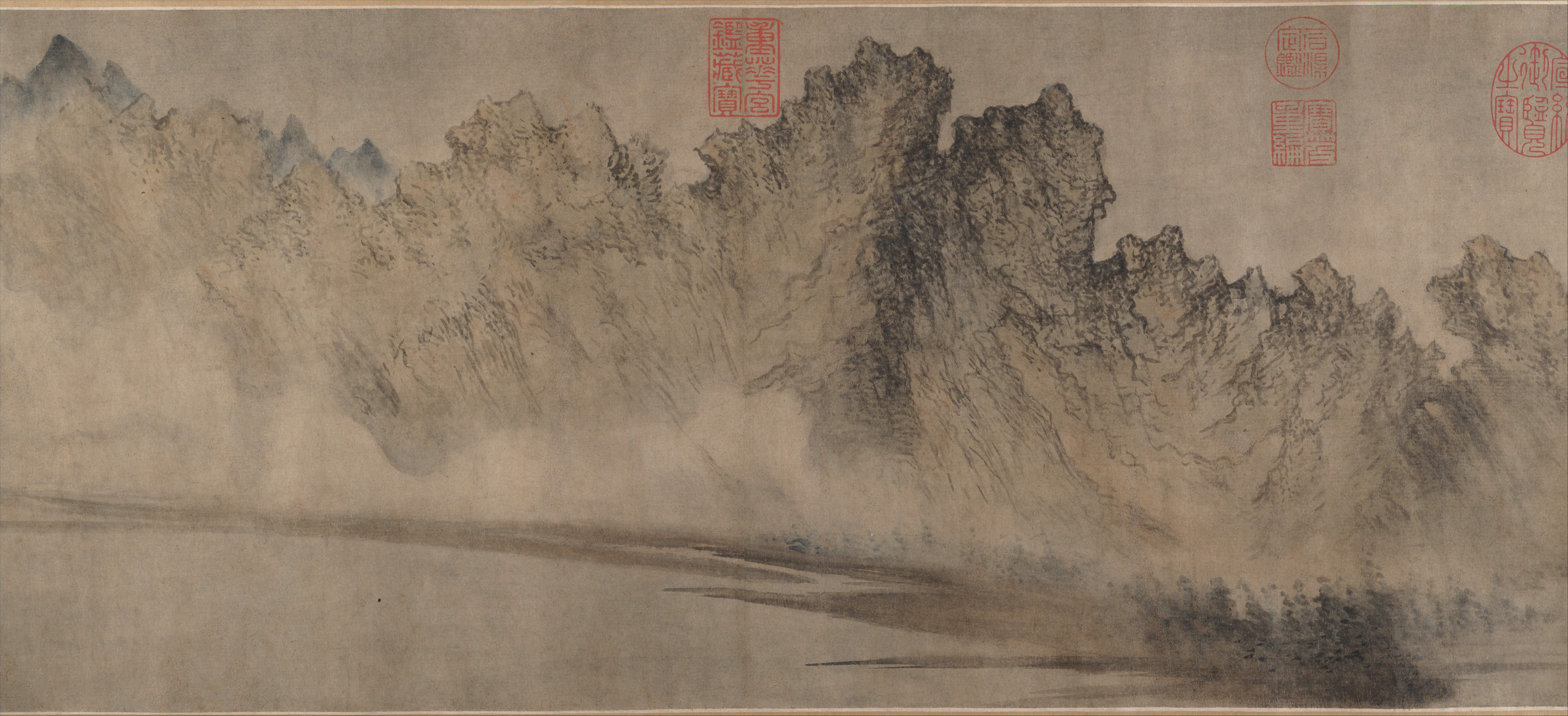
Then the world remains, restored to its boundless expanse, and man to his rank—neither at the summit, nor at the center, nor absent from it. The mountains fade into mist without our knowing where they end; and perhaps it is there, when we have ceased to demand their measure, that we begin to see them.
Sources cited
- Blaise Pascal, Pensées, ed. Wikisource, éd. Brunschvicg (1897).
- Lao-Tseu, Tao Te King, ed. Imprimerie royale, 1842 (Wikisource), trans. Stanislas Julien.