His Soul Is Tiger
Among the Kandozi of the Pastaza River, a man struck by grief does not seek solace: he goes to sleep alone in the forest, until his soul changes its nature. According to Usi Kamarambi, this is not an image of courage—it is a real transformation.
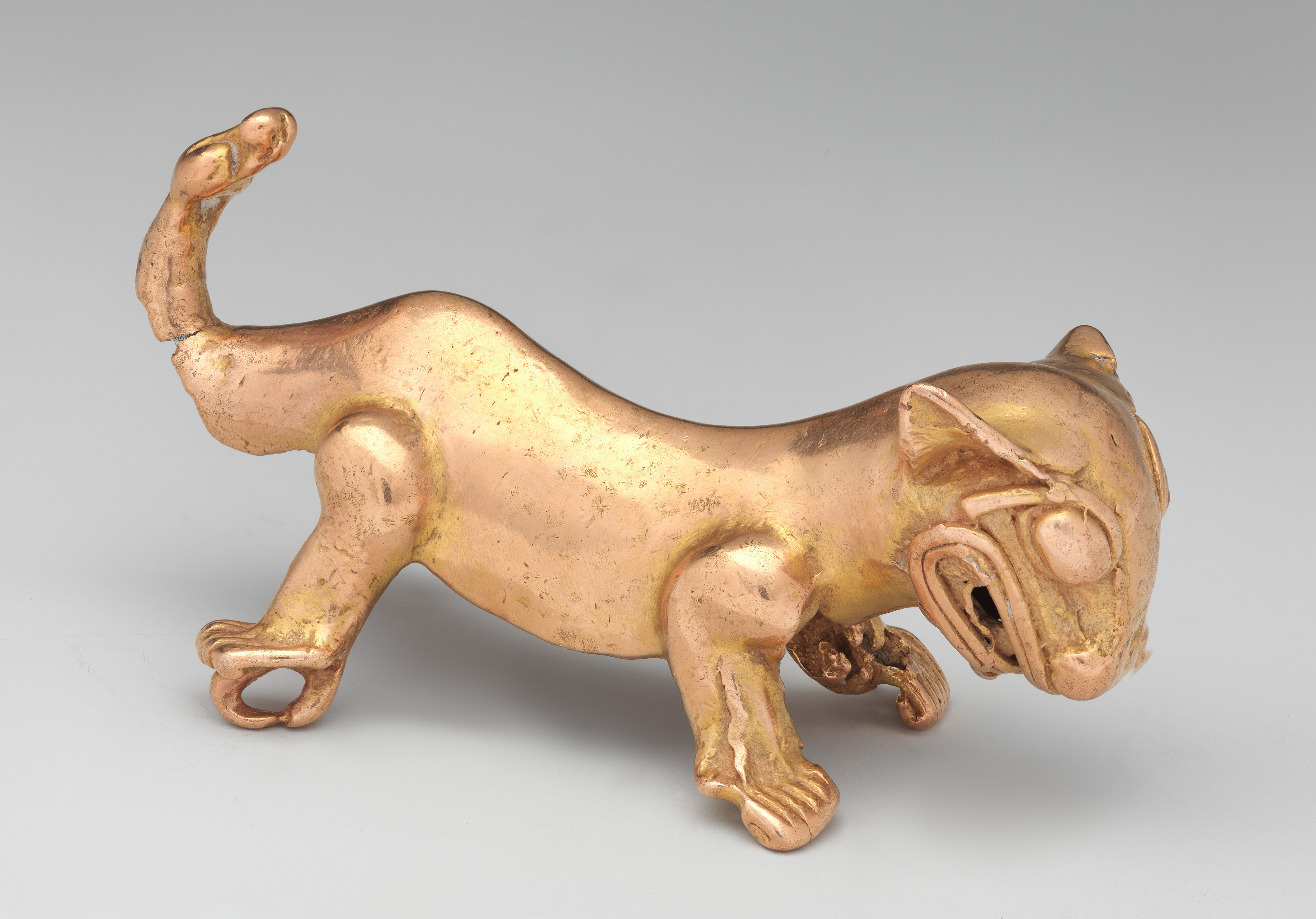
A Kandozi man has just lost a loved one. Grief keeps him awake; an old woman is called to “heal” him by blowing chapado tobacco into his eyes—to drive away bad dreams. It is not enough. Bitter, the man leaves to sleep alone in the forest, thinking: if my kin has died, perhaps I no longer have the power to live either. So he takes tobacco, ayahuasca, or toé, and sleeps in the thick of the monte—two days, sometimes more—until he obtains poder, power.
What Usi Kamarambi (José Hernando Zipina), a man of the Kandozi people living by the Pastaza River at Lake Musa Karusha, recounts is neither consolation nor metaphor:
Spanish El hombre que tiene su poder, tiene su espíritu de tigre. Como ya tiene su poder, es valiente y puede vivir más tiempo; sus enemigos no le pueden ganar porque su alma es tigre.
English The man who has his power has his tiger-spirit. Now possessing his power, he is valiant and may live longer; his enemies cannot defeat him, because his soul is tiger.
Nothing in the sentence suggests a figure of speech. Tiene su poder—he has his power—is said as one might say a man has a fever or a debt: a state of fact, measurable by its effects. And the effect is clear, in two stages. First, valiance and longevity—“es valiente y puede vivir más tiempo.” Then invincibility—“sus enemigos no le pueden ganar.” The cause of both is not courage forged in trial, nor a reputation won in battle. It is a single proposition, set down as a closing statement: porque su alma es tigre, because his soul is tiger.
The transformation does not end with the life of the man who earned it. When he dies, Usi Kamarambi adds, “su alma se queda aquí andando y a veces se transforma o tiene la voz de un tigre, de una boa, de un lagarto, de un gavilán”—his soul lingers here, roaming, and sometimes transforms or takes the voice of a tiger, a boa, a lizard, a hawk. This is no fleeting state, no seasonal bravery. It is a mutation that crosses death and continues to make itself heard after it—in a cry, a voice, more than in a fixed form: the tiger is not a guise the soul dons, but what it has become.
Two misunderstandings threaten such a statement, and they must be set aside before going further. The first: mistaking this for an inherited totem, an animal figure bestowed at birth and passed down through lineage, like a clan name. Nothing of the sort here—the Kandozi tiger-soul is received from no one: it is earned, man by man, grief by grief, through retreat and fasting. The second, closer to our own habits: hearing in “su alma es tigre” the equivalent of “he fights like a lion,” the metaphor we apply to the brave. But metaphor leaves the man untouched beneath the image; it compares without transforming. Here, by contrast, the soul does not resemble the tiger—it shares its substance, to the point of keeping its voice beyond the death of the man who bore it.
Another voice from the same collection, this one Awajún, also speaks of a power earned in solitude and fasting: the ajutap, that formless ancestor-being who comes, in the wind, to deliver a discourse on the life to come of the one who awaits. The resemblance ends where the real difference begins. The ajutap remains an other who appears—tiger of earth, eagle, floating head—and departs after speaking: the one who receives it keeps its words, not its substance. The Kandozi tiger-soul, on the other hand, is visited by no one. The man himself changes in nature, down to the voice he retains after death. Two neighboring peoples of the same basin, two distinct grammars of power: one summons it from elsewhere to speak; the other lets it arise in the very flesh of the one who fasts.
What grief opens in Usi Kamarambi’s account, then, is not a wound to be closed with tears. It is a passage—toward a state no single French word can capture, except by naming it as it comes: su alma es tigre, his soul is tiger.
Sources cited
- Usi Kamarambi (José Hernando Zipina), El ojo verde. Cosmovisiones amazónicas, ed. AIDESEP/FORMABIAP, 3ᵉ éd. corrigée et augmentée, 2025 (1ʳᵉ éd. 2000), p. 130-133, trans. texte original espagnol ; rendu français maison.