What the Lid Was Guarding
In 1844, an English artist lifts the lid of a tapu crate in a Waikato pā and finds only old clothes. According to Hirini Moko Mead, he saw only a prohibition—not the power he was touching.
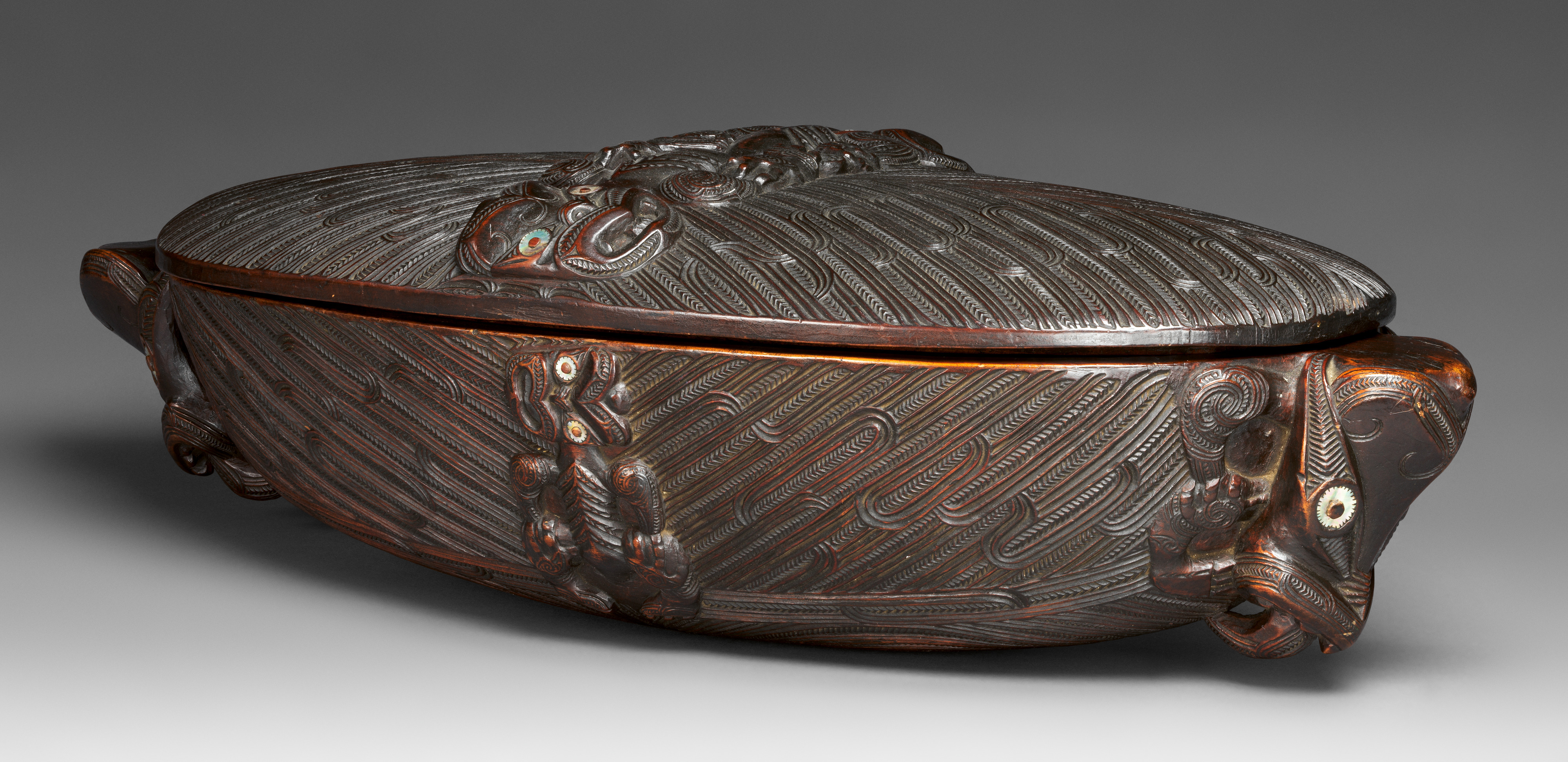
In 1844, the English artist George French Angas explores an abandoned pā in the Waikato district, searching for a fresh subject for his sketchbook. In one corner of the enclosure, a wooden crate raised on posts and topped with a small roof of twigs catches his eye. No one is watching. He lifts the lid.
English …I was curious to know what it contained, it was evidently tapu and on lifting up the lid found that it was filled with old garments, which I afterwards learned were the property of a very elevated person lately deceased, and these garments had been placed within this wahi tapu, under the most rigorous tapu by the tohunga: who would probably have pulled my ears had he discovered me peeping at these sacred relics.
English …I was curious to see what it contained; it was clearly tapu, and on lifting the lid I found it filled with old clothes—belonging, as I later learned, to a person of very high rank who had recently passed away, placed in this wahi tapu under the strictest tapu imposed by the tohunga: who would no doubt have boxed my ears had he caught me peering at these sacred relics.
Angas was not wrong: he had indeed read a prohibition. But he did not know what he was touching. A hundred and fifty years later, Hirini Moko Mead, an elder and scholar of Ngāti Awa, takes up the same word—tapu—and restores it to where it truly lives: not in a crate one closes, but in the entire fabric of Māori relationships.
English Tapu is inseparable from mana, from our identity as Māori and from our cultural practices.
English Tapu is inseparable from mana, from our Māori identity, and from our cultural practices.
Tapu, Mead writes, is everywhere: in people, places, buildings, objects, words, in all the right ways of doing. Its source lies with the primordial parents, Rangi the Sky and Papa the Earth, and their divine children—the lineages closest to the gods carry the most of it. Every Māori child is born already endowed with personal tapu, inherited with their genes; and just as a person’s mana grows with their conduct, their tapu rises in the same motion. The two ascend together, never one without the other.
From this come very concrete rules, which Mead lays out without emphasis: one does not step over a sleeping person, nor pass an object over someone’s head—the head being the most tapu part of the body. A new house is only opened at dawn, for it remains tapu until the carvers and builders have themselves been released from the tapu of their creative work. None of this is decorative: it is the same force, each time, that one measures and accommodates.
For tapu is never fixed forever. A gravely ill person, bleeding, sees their tapu rise dangerously; once the crisis passes, they become noa—not stripped of all tapu, Mead clarifies, but restored to a safe state, a reclaimed balance. This is the role of the tohunga: not to uphold the prohibition, but to lower what has risen too high.
The lid Angas lifted was not guarding old clothes. It was guarding a rank, a lineage, a share of mana that death had just rendered unstable, and which had to be kept out of reach until balance returned. The Englishman saw that he must not touch. He did not see what the thing depended on—or that, once the crisis had passed, it could have become noa. What the crate held was not a secret. It was a force one disturbs only with full awareness.
Sources cited
- Hirini Moko Mead, Tikanga Māori: Living by Māori Values, ed. Huia Publishers, 2003, trans. texte original anglais (voix māori nommée, Ngāti Awa) ; rendu français maison.
- George French Angas (cité par Mead), Savage Life and Scenes in Australia and New Zealand, ed. vol. 2, p. 35, 1847 ; extrait reproduit in Mead, Tikanga Māori, Huia 2003, p. 91, trans. texte original anglais (récit d'un visiteur colonial, 1844 ; regard extérieur) ; rendu français maison.