To Love What Nourishes
In the Hawaiian language as recorded by George Kanahele, the land is not named with a word of surface or property: ʻāina, 'that which nourishes.' And the love one bears it, aloha ʻāina, carries as its reverse a duty of care.
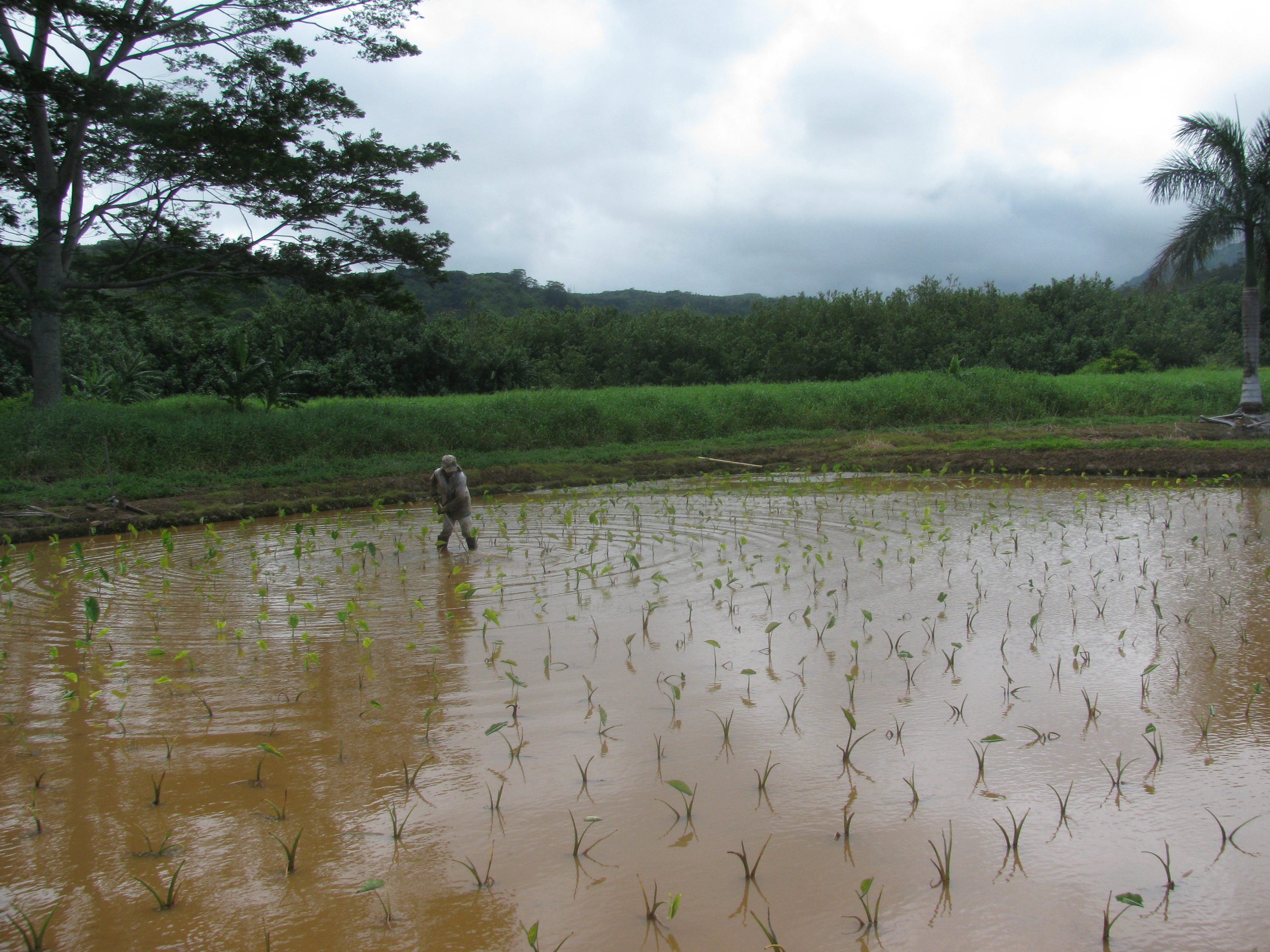
In a loʻi, a flooded terrace on Kauaʻi, a woman bends knee-deep in russet mud, transplanting young taro shoots. Behind her, the mountains hold the rain. It is an ordinary scene of labor—and, in the language of the place, a scene of kinship. For the Hawaiian word for the land where she works names neither soil, nor domain, nor surface. It names something else, which George Kanahele, a kanaka ʻōiwi scholar who spent his life recovering the values of his people, traces to a single etymology.
English …land, or ʻāina, literally, that which feeds. The word is derived from the noun or verb ʻai, meaning food or to eat, with the substantifier na added. ʻĀina links the occupation of the planter and the most vital life-ensuring function of eating.
English …the land, or ʻāina, literally, that which nourishes. The word derives from the noun or verb ʻai, meaning food or to eat, with the nominalizing suffix na. ʻĀina links the planter’s work to the most vital of functions: eating.
Everything lies in the name. Where French classifies land among resources—useful things, available, held in reserve—Hawaiian names it by the only gesture that matters when one is hungry: it nourishes. The land is not first a stretch to be surveyed, nor a possession to be held: it is the provider. Kanahele notes this with a smile—“only a truly agrarian people (or a people who love to eat!) could have coined such a word.” A people names its land this way only if it receives it as a gift that comes, not as a fund to be exploited.
If the land nourishes, the love one bears it is no mere embellishment of the soul: it is the fitting response to what one receives. Hawaiians name this love aloha ʻāina—love of the land—and Kanahele immediately marks its concrete reverse. Respect for the land, he writes, “is essentially a matter of mālama and aloha: care given with love.” Mālama, to care for. One continues to receive nourishment only by keeping alive the one who gives it; the relationship moves in both directions, as between a child and the parent who fed them. To love ʻāina is to care for it—and this care is not management, but piety.
English It means love of the land, or the country, and therefore can be synonymous with patriotism.
English This means love of the land, or of the country, and can thus be synonymous with patriotism.
The word patriotism might trip us up. We hear it turned toward a nation, a flag, a border—toward land held as collective property. But Kanahele shifts its object without rejecting it: what aloha ʻāina defends is not a state nor a land title, but the land-that-nourishes itself, the ancestor. Here, one does not fight for what one owns, but for the one from whom one descends and who has fed you. The word retains the fervor of patriotism while redirecting its recipient: instead of a country one brandishes, a provider one does not profane.
Our two words carve up what this one holds together. Resource places the land on the side of things, in reserve for our needs; ecology sets up a subject who administers opposite an object to be managed. In both cases, we remain standing before the land, at a distance, deciding its use. ʻĀina reverses the stance: the land is not before us, but beneath and before us, preceding us as a mother precedes her child, and it is she who nourishes. One does not manage the one who has fed you. One loves her, and cares for her—love and care being, in this word, one and the same debt.
Sources cited
- George Huʻeu Sanford Kanahele, Kū Kanaka — Stand Tall: A Search for Hawaiian Values, ed. University of Hawaiʻi Press, 1986, trans. texte original en anglais (chercheur kanaka ʻōiwi nommé) ; rendu français maison.