His Hair Are the Roots of the World
In the cosmovision Manuel Mibeco Ruiz speaks of for his people, the world is not a work the Creator set before Himself: it is His very representation, and each of His hairs is a root planted in a thing.
On the upper Amazon, between Peru and Colombia, Manuel Mibeco Ruiz—Lliíhyo in Bóóraá, “heart of the aguaje palm”—serves as curaca of the Brillo Nuevo community: he preserves tradition and leads the united clans of the Aguaje and the Pijuayo. With him speaks Gerardo del Águila Miveco, Íjkú Nuubúmu, “joyful paucar.” Together, they tell how the world was made. Before, they say, there was no earth: only water, where evil spirits dwelled. To display His power, the Creator brought forth the earth—and it came into the world in the shape of a woman’s breast. But this Creator is no craftsman who, once the work is done, withdraws.
Spanish Para el pueblo bóóraá el mundo es la representación del Creador. Por eso él se llama Píívyéji Niimúhe, que quiere decir ‘Creador de la tierra y de las cosas que existen en ella’.
English For the Bóóraá people, the world is the Creator’s representation. That is why He is called Píívyéji Niimúhe, which means “Creator of the earth and of all things that exist within it.”
The world is not an object the Creator fashioned and then left behind. It is His representation—His figure, His face turned toward us. The Bóóraá do not see the world as a product, but as a visage. And this name, Niimúhe, recurs with every act: creator of edible fruits, father of animals, maker of man—the Creator is not a fixed proper name, but a function that renames itself as it acts. What follows reveals where He stands within His own work.
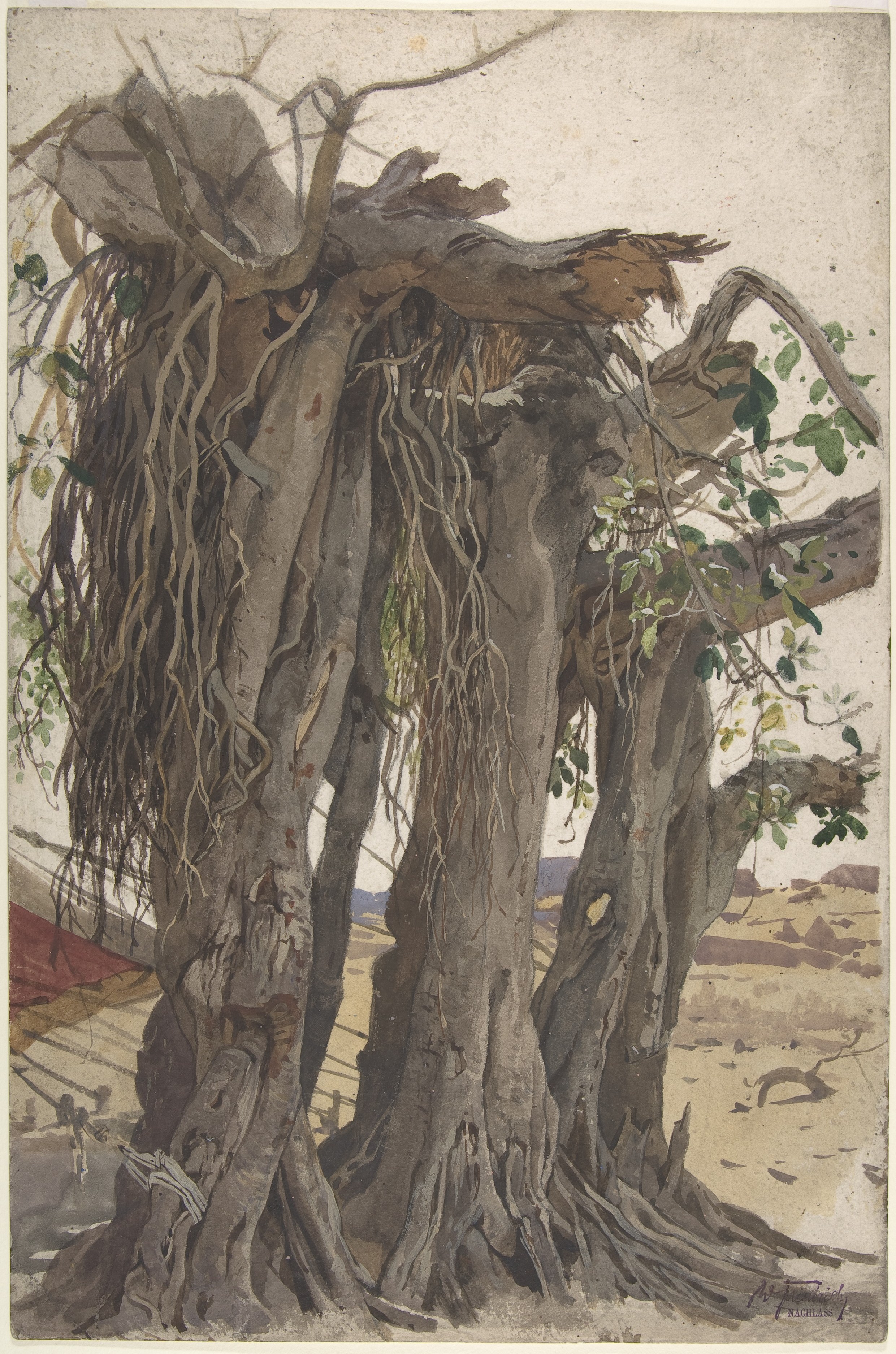
Spanish Niimúhe está enraizado en todas las cosas creadas por él. Esas raíces están representadas por cada uno de los pelos del Creador. Con la fuerza de su cabello protege al mundo y a través de esas raíces los hombres bora también se comunican con él.
English Niimúhe is rooted in all the things He has created. These roots are represented by each of the Creator’s hairs. Through the strength of His hair He protects the world, and it is through these roots that the Bora people also communicate with Him.
Here is the full image. The Creator is not above the world, watching over it: He is within it, rooted in every thing He has made. And what grows outward—the trees, the beasts, the waters, all that is visible—is His hair, the locks of a buried god whose tips we see. To protect the world, then, is not to watch over it from afar: it is to hold it by the root, because the world is that hair. And the root runs both ways. It is not merely what secures; it is a thread. The Bora do not speak to the Creator by lifting their eyes to the sky: they follow a root downward, into a thing, until they reach Him. Every living being is a strand leading back to its source—a cable through which prayer travels.
We, too, know a Creator. But ours, in Genesis, stands apart: He makes the light and sees that it is good—He beholds His work from without, separate from it, and on the seventh day He withdraws to rest. The Bóóraá Creator never withdraws. He remains like the root of all things; the world is not His work set before Him, but His very hair, His body still planted in every being. Where our God is transcendent—above, at a distance, observing—Niimúhe is immanent: beneath, within, holding. And our word for taking root, enrootment, names a need of the human soul: it is we who must root ourselves in a place. Here, the direction reverses. It is not the soul that seeks its ground, but the divine that is rooted in things, and the root is held out to us like a thread to speak to Him. Not man clinging to the earth, but the earth as the hair of a god, and that hair listens. This is what Mibeco leaves in our language: su cabello protege el mundo—a world held not from above, but by the hair, from within.
Sources cited
- Manuel Mibeco Ruiz (Lliíhyo) & Gerardo del Águila Miveco, El ojo verde. Cosmovisiones amazónicas, ed. FORMABIAP/AIDESEP, 3ᵉ éd. corrigée et augmentée, 2025 (1ʳᵉ éd. 2000), trans. texte original en espagnol (cosmovision bóóraá recueillie auprès de voix nommées) ; rendu français maison.