Asking the Master of the Waters
Carlos Nangkitiar Kunchim Tsanim, an Achuar man from the upper Pastaza, describes a world where fish, game, and gardens each have their own invisible owner—and where nothing is taken without first addressing him.
On the upper Pastaza, where the river descends from Ecuador into Peru, an Achuar man gazes into a deep pool. The water teems with fish. Yet to him, these fish are not free for the taking—they have an owner, who dwells in the depths. One does not help oneself in another’s home. The man’s name is Carlos Nangkitiar Kunchim Tsanim—he explains that it means “spear for waging war”—and in the collection El ojo verde, where Amazonian voices themselves articulate their people’s thought, he has shared the shape of the world as he received it.
Spanish Mi nombre es Carlos Nangkitiar Kunchim Tsanim, que significa ‘lanza para guerrear’; soy de Puerto Rubina. La forma del mundo, según la cosmovisión achuar, la aprendí oralmente de mi abuelo, mis abuelitas y mis tíos.
English Je m’appelle Carlos Nangkitiar Kunchim Tsanim, ce qui signifie « lance pour guerroyer » ; je suis de Puerto Rubina. La forme du monde, selon la cosmovision achuar, je l’ai apprise oralement de mon grand-père, de mes grands-mères et de mes oncles.
The Achuar world is layered. The first tier lies beneath the water, inhabited by the tsungki—beings with human faces who live in the depths of great pools and beneath waterfalls, and who own the fish. The tsungki are the masters of fish and other aquatic creatures, Nangkitiar explains; that is why fish abound where they reside. They are not forces: they are proprietors, with furnished homes of their own.
Tsungki is not alone. Game has its master, Mana; the garden has its mistress, Nungkui, who lives beneath the earth. And from the fact that each domain has its owner follows a rule that is no mere metaphor: one does not take, one asks. The cornerstone of this world is not a belief in the unseen, but a gesture.
Spanish Hay seres visibles e invisibles en la naturaleza, con los cuales el ser humano se relaciona mediante el “discurso”.
English Il y a, dans la nature, des êtres visibles et invisibles, avec lesquels l’être humain entre en relation au moyen du « discours ».
This “discourse” is no vague prayer: it is an address, directed to a specific master, at a precise moment. Before setting a trap, the hunter must deliver a discourse, asking the master of the animals to permit the birds to approach the snare. The woman who heads to her garden with a basket must always speak to Nungkui, who dwells beneath the earth. Harvesting is never a simple act of taking—it is a word offered to an owner. As for Tsungki, the master of the waters, ordinary people do not meet him: only the wishín, the one who knows, deals with him; others hear him at night, deep in the pool, and do not descend. The world has its closed doors, and the Achuar know it.
Here, it would be easy to draw hasty parallels. We have already encountered, among the Ainu, the kamuy: the owl, the fire, the water regarded as persons rather than “nature.” But the tsungki is no kamuy, and the distinction is everything. The kamuy is a guest—a being who visits the human world, to be welcomed or offended. The tsungki is an owner—a being in whose home one enters, and to whom what one wishes to carry already belongs. One founds an ethic of hospitality; the other, an ethic of permission.
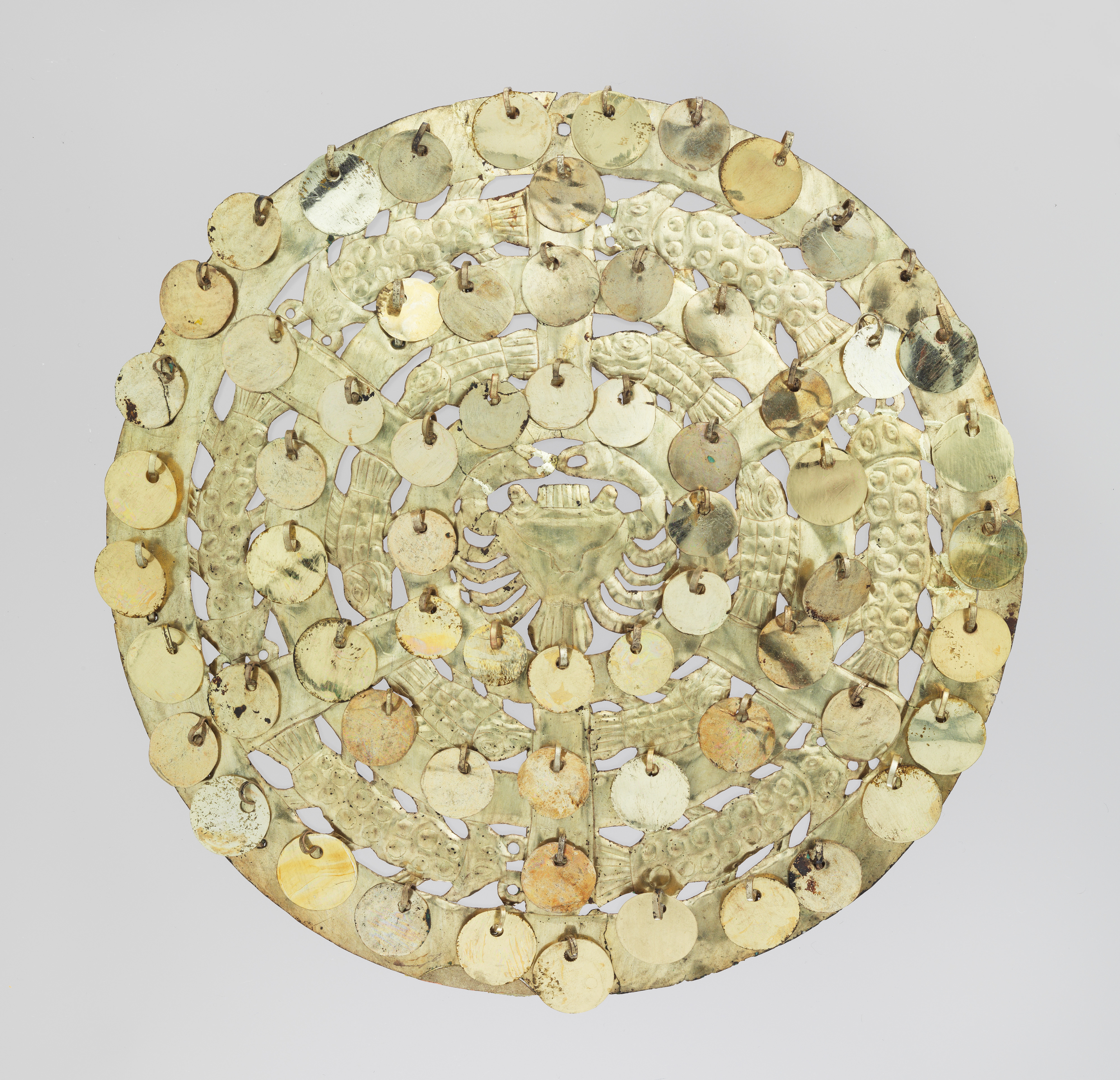
This is where the Achuar word undoes our own. We speak of “resources”: a masterless stock, lying there for the taking, needing only to be managed. Nangkitiar’s world knows no such stock. Fish belong to Tsungki, game to Mana, harvest to Nungkui; nothing is unowned, and thus nothing is there to be taken—everything must be asked for. On the Moche shield, the crab and golden fish circle a central figure, like the master of the waters’ household around his seat. The question is not whether there are fish in the river. It is to whom they belong, and whether one has remembered to ask.
Sources cited
- Carlos Nangkitiar Kunchim Tsanim, El ojo verde. Cosmovisiones amazónicas, ed. FORMABIAP/AIDESEP, 3ᵉ éd. corrigée et augmentée, 2025 (1ʳᵉ éd. 2000), trans. texte original en espagnol (cosmovision recueillie auprès de la voix achuar) ; rendu français maison.