Losing Oneself in the Sun
ʿAttār leads the birds to the Simurgh: the final valley erases the one who walks. Simone Weil undoes the self—without ever calling herself the sun.
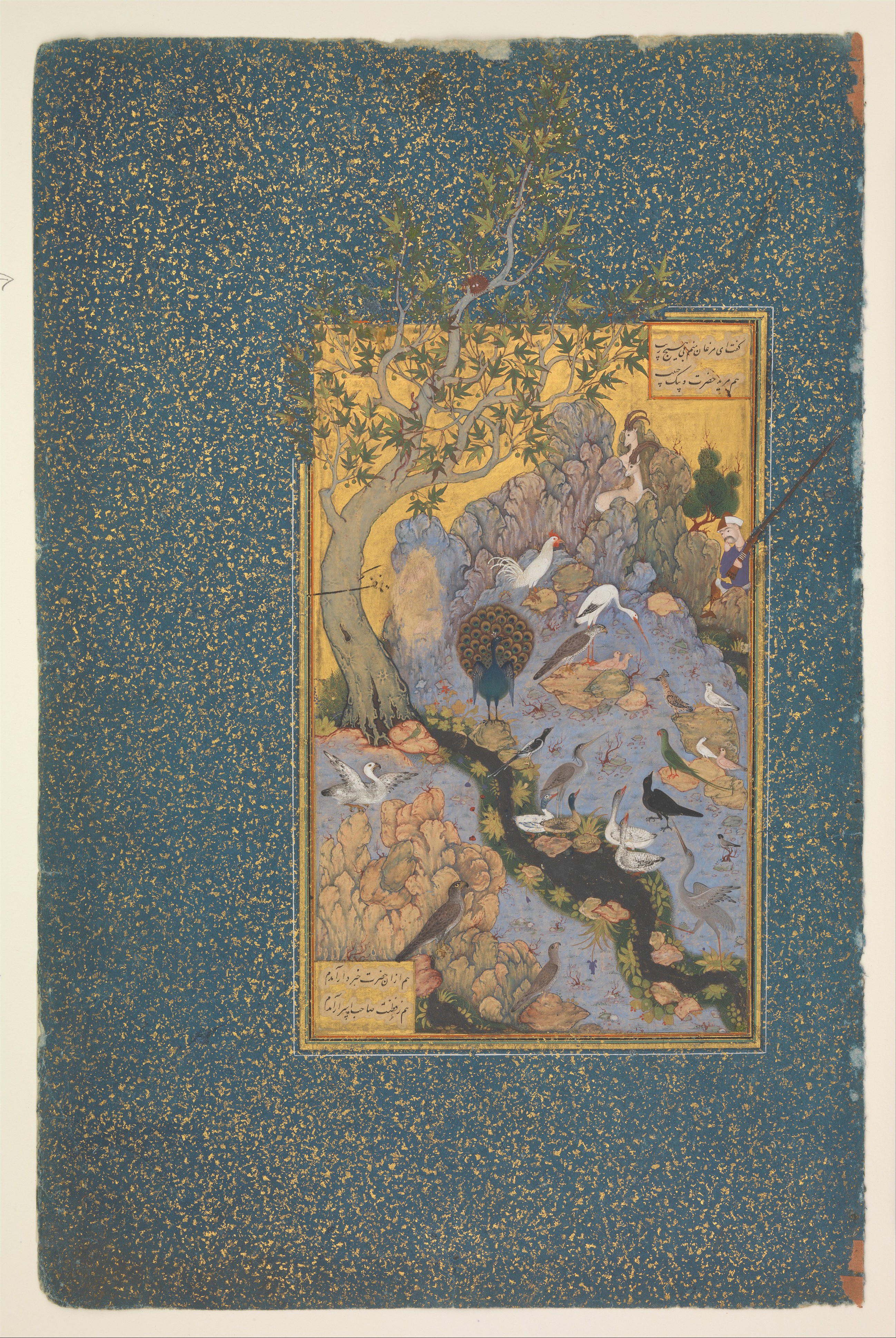
The birds of the world gather; they seek a king, and one among them—the hoopoe, already wise to the path—points them toward one: the Simurgh, the sovereign bird who dwells beyond the Caucasus mountains. The journey will be long. Many will abandon the idea before setting out, others will lose their way. But what astonishes in the hoopoe’s announcement is not the difficulty of the road. It is the destination.
The first valley that lies ahead is that of the quest (talab); the next is that of love (ʿishq), which knows no bounds; the third is that of knowledge (maʿrifa), the fourth that of independence (istighnāʾ), the fifth that of pure unity (tawḥīd), the sixth that of bewilderment (ḥayrat), and the seventh, finally, that of poverty (faqr) and annihilation (fanāʾ), beyond which no further advance is possible.
Seven valleys, and the last bears a name that is not that of an arrival.
One expects a palace, a throne, the face of the king. Attar places at the journey’s end the effacement of the one who walks. This is no poet’s trick of deferred disappointment: it is the very heart of what he offers. As long as a traveler remains to reach the goal, the goal is not reached—the traveler is the final obstacle. The seventh valley does not open onto some beyond; it dissolves the one for whom a beyond could still be lacking. “There you will be drawn in, yet unable to continue; a single drop of water will be to you like an ocean.” The drop does not cross the ocean: it loses itself in it, and in this loss, it reaches it.
What remains is the secret the hoopoe guards—or rather, the one she let slip long before departure. To seek the Simurgh is to already hold it as other, distant, separate. The poet undoes this distance. “Make of your soul a mirror to behold the radiance of your Friend,” he says; “every form that appears to you in the desert must truly be the mysterious shadow of the Simurgh.”
Whether there be thirty birds (si-murgh) or forty, all that you see is the shadow of the Simurgh. The Simurgh is not distinct from its shadow […] If, on the contrary, you discover that the shadow is lost in the sun, then you will see that you yourself are the sun.
The Persian word closes the trap with a goldsmith’s gentleness: si murgh means “thirty birds.” At journey’s end, those who remain—decimated, emptied of themselves—bear the very name of what they sought. The seeker was the sought. Not that there was nothing to find: there was the loss of the shadow, so that the sun it had never ceased to be might appear.
What is annihilation (fanāʾ) in Attar?
It is the seventh and final valley of the path described in The Language of the Birds: the effacement of the self that seeks. Attar does not promise arrival at a place, but the disappearance of the traveler. The shadow lost in the sun then discovers it was light—the seeker and the sought were one.
Another voice, from a wholly different world, names a kindred gesture—and it is another path, one that must not be confused with the first. Simone Weil forges a word for this effacement: decreation.
Decreation: to pass from the created into the uncreated. Destruction: to pass from the created into nothingness. A guilty substitute for decreation.
The distinction she draws at the outset holds for her entire path: to decreate is not to destroy. Destruction casts the created into nothingness; decreation passes it into the uncreated—toward greater reality, not toward void. The self consents to no longer be the center. “We must renounce being anything,” she writes; not out of self-contempt, but because this self occupies the place of something else.
And here the two paths diverge sharply. For Weil never writes, “you yourself are the sun.” She writes the opposite:
If we were exposed to the direct radiance of His love, without the protection of space, time, and matter, we would evaporate like water in the sun; there would not be enough I in us to surrender the I out of love.
The same sun, then, and two opposing gestures before it. In Attar, the shadow is lost in the sun and recognizes itself as sun: annihilation reveals an identity, the seeker discovers they were never separate. In Weil, the self exposed without veil to the sun would evaporate; what remains, beneath the veil, is just enough “I” to still give it away out of love. She undoes the self only to leave a space: not to claim divinity for herself, but so that God may be there, where she has ceased to be. In one, the drop becomes the ocean; in the other, it consents not to be, and what fills the hollow is never her.
One might stop here, at the divide. That would be too soon. For beneath the divergence lies the same narrow door: both name the separate self—the shadow, the “I”—as the sole veil, and its undoing as the only passage. Neither takes this self as the journey’s goal; both make it the very obstacle. Only, behind the fallen veil, one sees that we were the light, and the other, that the light is not us—and that this, at last, is why we may love it. The same veil named, a different light.
Two paths, then, and a question neither answers for the reader: what we pursue so far—do we await it at the journey’s end, or in the absence of the one who journeys?
Sources cited
- Farîd al-Dîn ʿAttâr, Le Langage des oiseaux (Mantic Uttaïr), ed. Imprimerie impériale, 1863 (transcription remacle.org), trans. Joseph Héliodore Garcin de Tassy.
- Simone Weil, La Pesanteur et la Grâce, ed. Librairie Plon, 1948 (recueil établi par Gustave Thibon).