Act, and Release the Fruit
The Bhagavad-Gītā does not command retreat, but action—stripped of the one thing we truly cling to: its outcome
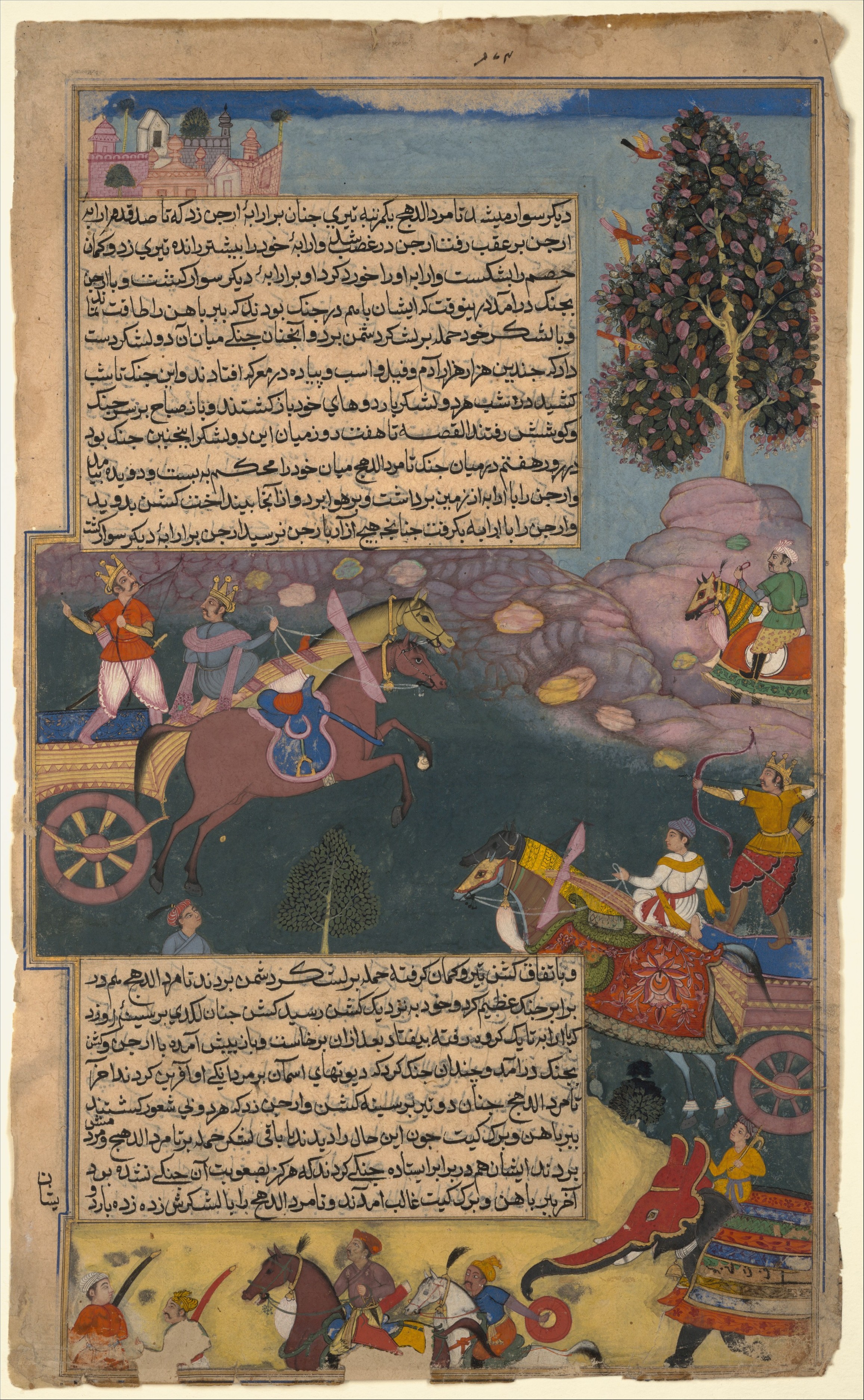
Arjuna, the greatest archer of his age, halts his chariot between the two armies drawn up in battle order and refuses to fight. Across the field, among the enemy ranks, he recognizes his teachers, his cousins, his own kin. He lets his bow fall: “I will not fight,” he says, then falls silent. The seven hundred verses of the Bhagavad-Gītā are Krishna’s answer, spoken to set him back on his feet. One might expect consolation, or a command. Krishna does something else entirely: he shifts the question of action toward what the agent hopes to gain from it.
Be intent upon the performance of works, never upon their fruits; do not act for the sake of the fruit, yet do not seek to avoid action.
A single sentence, two symmetrical refusals. It is forbidden to act for the fruit—to make the deed a mere means stretched toward its yield; it is equally forbidden to flee the deed. Both errors share the same root: the eye fixed on the outcome, whether coveted or feared. Krishna’s path is neither. Act fully, and sever the thread that binds the gesture to what it yields.
One must hear where this is spoken. Not in a hermitage: on a battlefield, to a warrior who would precisely lay down his arms. The Gītā is the least quietist of contemplative texts. Krishna does not propose that Arjuna withdraw from the world; he urges him to act within it—“do not seek to avoid action.” What wisdom cuts away is not action, but its possession. Where the Taoist sage recedes to let emptiness operate, the Gītā demands the bow be drawn—but without clinging to the arrow’s strike.
Steadfast in mystical Union, perform the work and cast off desire; be the same in success and failure; Union is equanimity of soul.
Equanimity of soul is not the indifference of the slothful, who spare themselves effort. It is effort fully undertaken, minus expectation. One aims true, and accepts in advance that the arrow, once loosed, no longer belongs to us. Krishna goes even further than detachment from the result: he reaches the one who believes himself the agent. “He who, through ignorance, considers himself the sole author of his acts sees poorly and understands not.” To renounce the fruit is also to cease claiming sovereign authorship of the gesture—and to offer the act to that from which all beings emanate.
Here, a Western reader might think they recognize a familiar face. The injunction seems Stoic: do not fix your desire on what you do not control. Epictetus opens his Manual with this exact division.
Among things, some depend on us, others do not. Those that depend on us are opinion, choice, desire, aversion—in a word, whatever is our own doing. Those that do not depend on us are the body, possessions, reputation, office—in a word, whatever is not our own doing.
The very word “doing” echoes, and one might be tempted to conclude they are the same. That would be too hasty. Beneath the shared maxim, two opposite movements. Epictetus builds a fortress: judgment, will, are mine, free, inviolable; the rest—the body, glory, outcome—is foreign to me, and before it I must be able to say “nothing here concerns me.” The self retreats into the only domain it possesses and reigns there unchallenged; this is the Stoic’s inner citadel, fortified. The Gītā does the reverse. Letting go of the fruit does not consolidate any citadel: it unbinds the self, returns it, acknowledges that one was never even the sole agent of the act. Where Epictetus strengthens the “I” by withdrawing it to its territory, Krishna dissolves it. The same surface—do not cling to the outcome—over two inverse depths: one firms up the subject, the other undoes it.
The convergence was only apparent, and it had to be undone before it could be believed. What remains is what both refuse together, and which concerns us. Our age evaluates every gesture by its yield: the result, the return, the measurable outcome. Even rest, even attention, are now judged by what they produce. Under this light, verse 47 becomes nearly inaudible—an act that does not aim at its fruit resembles waste. Culture has even managed to reclaim “detachment”: letting go to perform better, detaching to optimize, calculated release whose secret aim remains the fruit. This is precisely the ruse Krishna forbids. One does not renounce the fruit in order to secure it more surely. One renounces it because it was never entirely ours—no more than the act was entirely our doing.
Arjuna rises and fights. Not because he has conquered his turmoil through the force of will, as the Stoic would in his citadel, but because he has ceased to believe himself the owner of the outcome, or even the author of the gesture. The bow returns to his hand. The fruit, however, was never there.
Sources cited
- Anonyme (Mahābhārata), La Bhagavad-Gîtâ, ou le Chant du Bienheureux, ed. Wikisource (Librairie de l'Institut, 1861), trans. Émile-Louis Burnouf.
- Épictète, Manuel, ed. Wikisource (trad. Guyau, 1875), trans. Jean-Marie Guyau.