Providence or Atoms
Marcus Aurelius holds death to be dispersion or transformation—whether providence or atoms, fear falls away on both counts. Epicurus keeps only one of the two paths and carries it to its end: where death is, we are no longer.
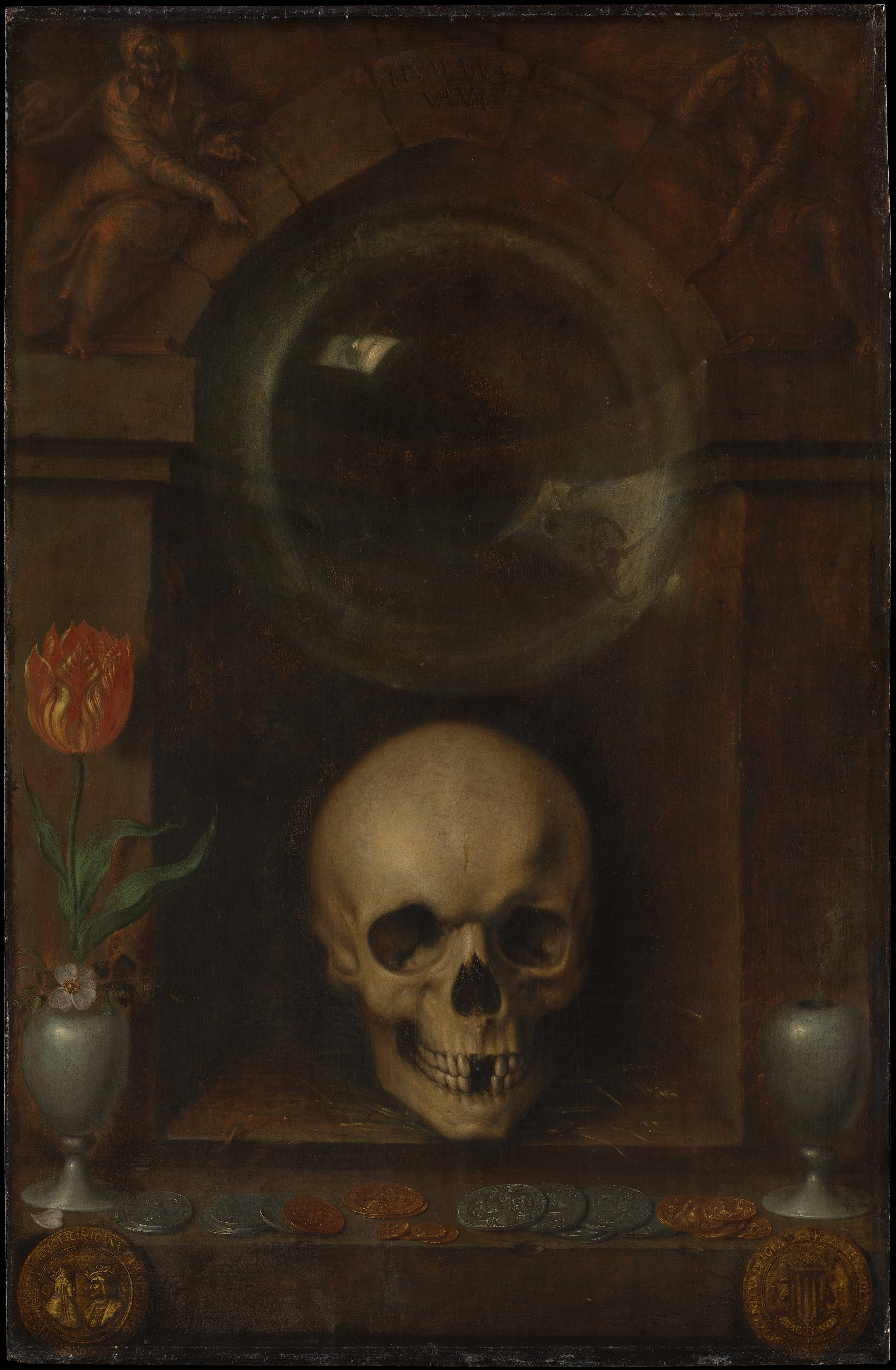
 The mind shrinks from its own end as the hand from flame. It knows the end is certain yet contrives not to look—pushing it to the edge of vision, entrusting it to others, postponing it. An emperor who wrote by night, for himself alone, took the opposite course: to place the thing at the center, turn it over, examine it coldly. Not to be frightened by it, but to see whether fear, once examined, still stands.
On death. If it is a dispersion of the elements that compose us, it is either dissolution into atoms, or annihilation, or extinction, or transformation.
He offers no comfort in promises of survival, nor in denial of death. He takes inventory. Death is a change: either the elements that make us up unravel into atoms, or they pass, transformed, into the order that reclaims them. The Meditations return again and again to this alternative without ever resolving it—either an intelligent reason governs all, or there is only the chance meeting and scattering of atoms. And it is from not resolving it that peace arises: whatever the truth, fear loses its ground.
Either in this world everything flows from a single source, which is intelligent, as in one vast and single body; and in that case, a part has no right to complain of what is done for the sake of the whole; or else there are only atoms in the world, and nothing but their fortuitous meeting or their dispersion. Why then be disturbed or troubled?
In the first branch, the world is a single living body, pervaded by one reason; death returns to the whole elements that never truly left it, and the part has no cause to complain of what serves the whole. In the second, when all unravels, nothing remains but “elements that feel nothing”: no one is left to be wronged. The Stoic foundation leans toward the first—a trust in order. But Marcus Aurelius holds the second to be valid, and notes that it disarms fear just as effectively.
What, exactly, do we fear in death?
We believe we fear death; in truth, we fear witnessing it—being present at our own absence, spectators of our own nothingness. Yet this is the one scene from which the spectator is removed. Where I am, death is not yet; where it is, I am no longer. Fear requires a witness whom the event itself eliminates.
This is the second branch that a Greek, nearly five centuries earlier, had made entirely his own—rejecting the first. For Epicurus, no providence, no governing reason: only atoms, void, and gods too blissful to concern themselves with us. His consolation rests on no trust in order; it depends solely on the logic of sensation, in service of a single aim—undisturbed calm, ataraxia. “Death is nothing to us,” he tells Menoeceus, “since pain or pleasure depends on sensation”—and death is nothing but the privation of sensation.
Death, once again—the most dreaded of all evils—is but an illusion, for as long as we live, it is not; and when it comes, we are no more: thus it holds no sway over the living or the dead. The former do not yet feel its fury, and the latter, who no longer exist, are beyond its reach.
Two worlds stand opposed here in every respect: on one side, a whole one may inhabit with trust, to which one surrenders; on the other, a rain of indifferent atoms where one ceases, without remainder. One entrusts death to an order; the other empties it of any subject to whom it might occur. They cannot be reconciled: Stoic serenity is an assent, Epicurus’ a subtraction. Marcus Aurelius himself names Epicurus’ world as one of the two branches he weighs—and does not embrace.
Yet the two paths converge without merging. Whether one sees oneself as a drop returned to the ocean of reason, or a figure undone into elements that feel nothing, no one remains, in the end, to suffer the loss. Epicurus speaks of his godless world: the dead “are beyond its reach.” Marcus Aurelius speaks of his, full of providence: what unravels serves the whole, and the part does not complain. Metaphysics remains divided—an order that receives, or a void where one is no more; deliverance, however, is one.
This is what practicing death meant to the ancients: not to be fascinated by nothingness, but to hold this alternative before one’s eyes until fear loosens its grip. The meletē thanatou, the exercise of death, does not turn away toward an afterlife; it returns one wholly to the conduct of today. The superfluous witness removed, no one remains, on either side, to whom death happens.
Sources cited
- Marc Aurèle, Pensées pour moi-même, ed. Wikisource (trad. Barthélemy-Saint-Hilaire), trans. Jules Barthélemy-Saint-Hilaire.
- Épicure, Lettre à Ménécée, ed. Lefèvre, 1840, trans. Jacques Georges de Chauffepié.