Small Before the Vast
The same immensity soothes Marcus Aurelius and overwhelms Arjuna—two ways of ceasing to be the center.
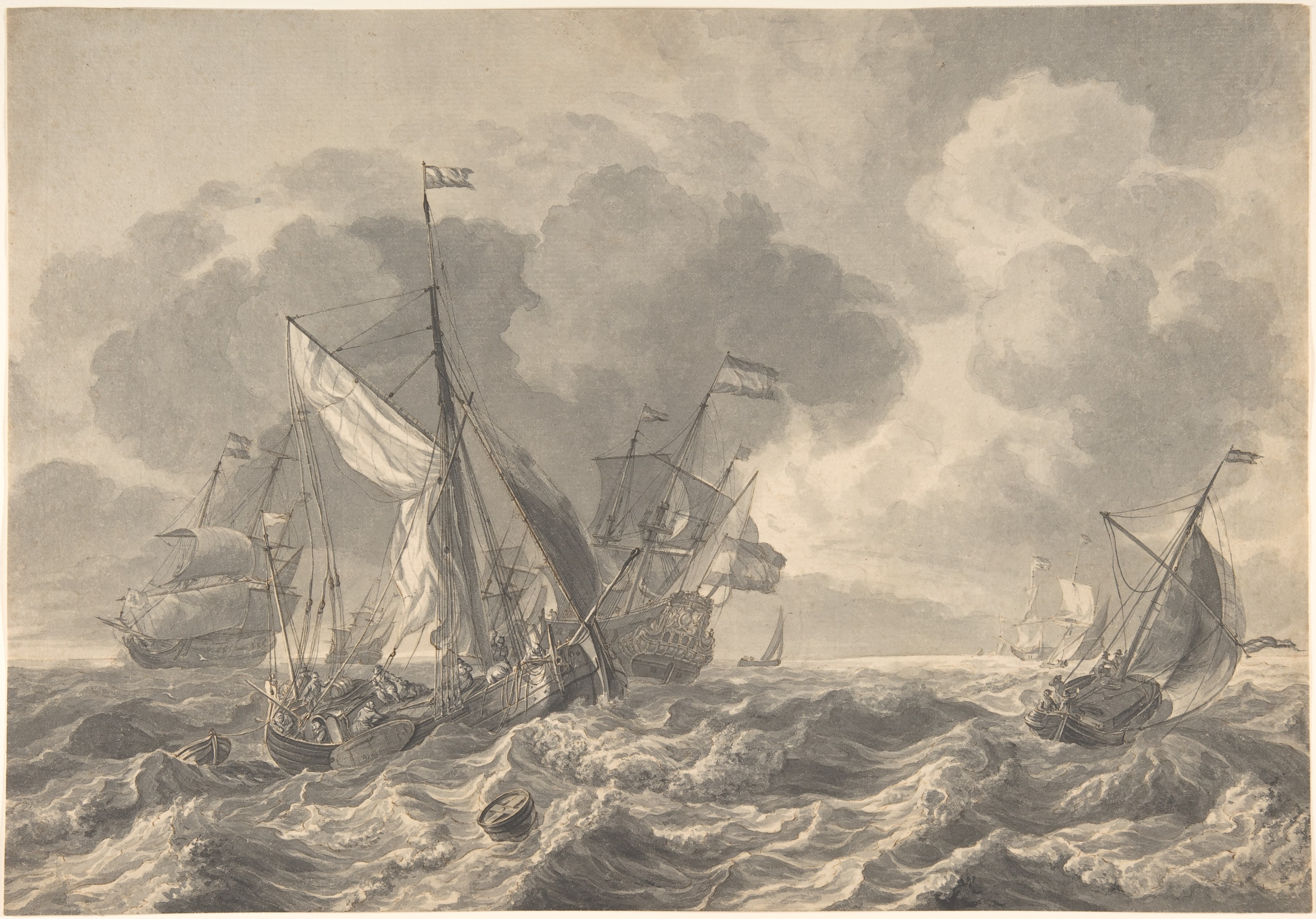
 Open your eyes wide enough, and the entire sea fits into a drop. The Ancients practiced this exercise with their eyes closed: lifting themselves in thought above the world, then watching it shrink from that height. The empire becomes a speck, fame a murmur in some corner, a life the span of a heartbeat. Marcus Aurelius turns to this each evening, in his tent, in a notebook written for no one but himself.
Asia and Europe are lost in some corner of the world; the whole sea is but a drop of water in it; Mount Athos, a clod of earth. All the time we can measure is but an instant in eternity. Everything is petty, shifting, perishable.
The gesture may seem cruel: to reduce everything, to flatten it all. It is not. Marcus Aurelius does not belittle the world to lament it; he restores it to its true scale to free himself from it. What swells in the chest—a hoped-for honor, a received insult, the fear of ending—loses its weight the moment it is measured against the whole. And the very next sentence prevents this smallness from turning into nothingness: “Yet all things come from that common principle which governs the universe.” The drop is not lost; it belongs to the sea. The clod, to order. To see oneself as tiny is, for him, to reclaim one’s place—and with that place, calm. The view from above is a discipline of reason: one rises above the vast, measures it, and measuring soothes. Ataraxia is won here through a subtraction of the self.
Why does the same immensity soothe one and overwhelm the other?
Because there are two ways of being small before the vast: to survey it from above, or to receive it full in the face. Another text, born at the other end of the world, shows the exact reverse of the Roman exercise. On a battlefield, before the fight, a warrior asks to see the god as he truly is. The favor is granted—and what he sees cannot be measured from without: it crashes down upon him.
I see you with countless arms, chests, faces, and eyes, with a form utterly boundless. Without end, without middle, without beginning, thus do I behold you, Lord of the universe, universal form.
This viśvarūpa, this universal form, soothes nothing. Where the empire became a speck, here entire worlds vanish into innumerable mouths. The seer does not dominate the scene: he is caught within it. “Seeing your gaping mouth and your great blazing eyes, my soul is shaken, I cannot find my footing or my calm,” Arjuna confesses (XI.24). And the form speaks, which the Stoic cosmos never does: “I am Hāla, Time the destroyer of worlds; old, I have come here to annihilate the generations” (XI.32).
Let us first keep the two texts apart, for they do not describe the same vastness. That of Marcus Aurelius is an ordered, impersonal Nature, which reason embraces with a single gaze: one stands above it, and breathes. That of the Gita is a personal, devouring Time, which no gaze can overlook: one kneels within it, hair standing on end. The one contemplates the immense; the other is contemplated by it. Smallness consoles the first, it strikes the second like lightning. To confuse the two would be to have read neither: the serenity of the Stoa is not the sacred terror of the field of Kurukṣetra.
And yet both texts do the same thing to the self. They dislodge it from the center. Marcus Aurelius sees that nothing belongs to him alone: the drop belongs to the sea, he himself to “that common principle which governs the universe”; he is not the author of the world, but a part carried by it, and he consents to his portion. The Gita draws the same conclusion from immensity, by the other slope. Since Time has already accomplished everything, the warrior need not believe himself the agent of what he does: “I have already ensured their destruction: be merely the instrument” (XI.33). To act, yes—but without claiming its source, as we have seen renouncing the fruit of action without renouncing action.
Here is the summit where the two paths meet without merging: to cease taking oneself for the measure and origin of things. The Roman sage ascends by reason, which consents to an order it understands; the warrior is cast there by devotion, which bows before a mystery that surpasses him. Serenity and terror are not the same door—but they open onto the same chamber: a self no longer at the center. It is the same retreat from oneself that Marcus Aurelius proposes elsewhere, accomplished here by the mere sight of what exceeds him.
One question remains, which neither resolves for us: do we discover our smallness by looking down upon the world, or by suddenly being looked upon by it?
Sources cited
- Marc Aurèle, Pensées pour moi-même, ed. Germer-Baillière, 1876 (trad. Barthélemy-Saint-Hilaire), trans. Jules Barthélemy-Saint-Hilaire.
- Bhagavad-Gîtâ, Bhagavad-Gîtâ, ed. Librairie de l’Institut, 1861 (trad. Burnouf), trans. Émile Burnouf.