The God Sings 'I'
In the Ainu yukar transcribed by Chiri Yukie, epic is not a tale about beasts: it is the owl, the frog, the orca who recounts its own visit to the human world, in the first person, saying 'I.'
A man lies on his back by the hearth, beating time with his hand against his chest, and a voice rises. It says “I.” But this “I” is not his: it belongs to a frog, a fishing owl, an orca. In the songs Chiri Yukie transcribed from Ainu in 1922 at the age of nineteen, the narrator is almost never human. The titles leave no room for doubt: The Owl Sings of Itself, The Frog Sings of Herself. The one who speaks is the beast—and the beast is a god.
English (translated from Ainu) “Toororo hanrok, hanrok!” One day I was spending time amusing myself hop-hopping where the dense weeds grow, when I looked and there was a house […] In this way I am now about to die a mean death, an awful death, and so you frogs who come after me, make sure you do not play evil tricks on the humans. With these words the frog with the bloated belly died.
English « Toororo hanrok, hanrok! » One day, as I was hopping about for fun, hop, hop, where the grass grows thick, I looked: there was a house […] Now I am about to die a wretched death, a terrible death; and you, frogs who come after me, beware of playing tricks on humans. With these words, the frog with the swollen belly died.
Everything hinges on grammatical person. The frog recounts its own prank, its own punishment, even its own death: “now I am about to die.” The “I” holds until the last breath. A single line, at the very end—With these words, the frog with the swollen belly died—shifts to the third person, just long enough for the human voice to reclaim the song and bring it to a close. All the rest belongs to the beast. That is what a yukar is: not a tale about the animal, but the animal speaking for itself.
The scholar Donald Philippi, who established the definitive translation of these epics, formulates the rule—from an outside perspective, but grounded in the texts the Ainu themselves preserved: the entire song is “a monologue told by a single speaker,” a monologue sustained from beginning to end by one voice, without Muse or Spirit of Song intervening. And in the kamui yukar, that speaker is the god itself: it appears, takes the floor, and the narration never leaves its point of view. The form does not illustrate belief; it enacts it. To give the owl a voice, a grammar had to exist in which the owl could say “I.”
Chiri Yukie understood this better than anyone. The first Ainu to transcribe her people’s oral literature—not as an outsider folklorist—she does not record, in her preface, stories about gods: she saves voices.
English (translated from Ainu) I who was born an Ainu and grew up with the Ainu language have written down with my halting brush just one or two very short pieces from among the sundry tales that our ancestors enjoyed relating on rainy evenings and snowy nights, whenever they had time to get together.
English Born Ainu and raised in the Ainu language, I have set down with my faltering pen two or three brief pieces from among the tales our ancestors loved to tell, on rainy evenings and snowy nights, whenever they had time to gather.
Her “faltering pen” writes in Latin letters a language without an alphabet, to preserve songs in which the god keeps its own mouth. The gesture is precise: to transcribe a yukar is not to tell the frog’s story, but to lend it speech once more.
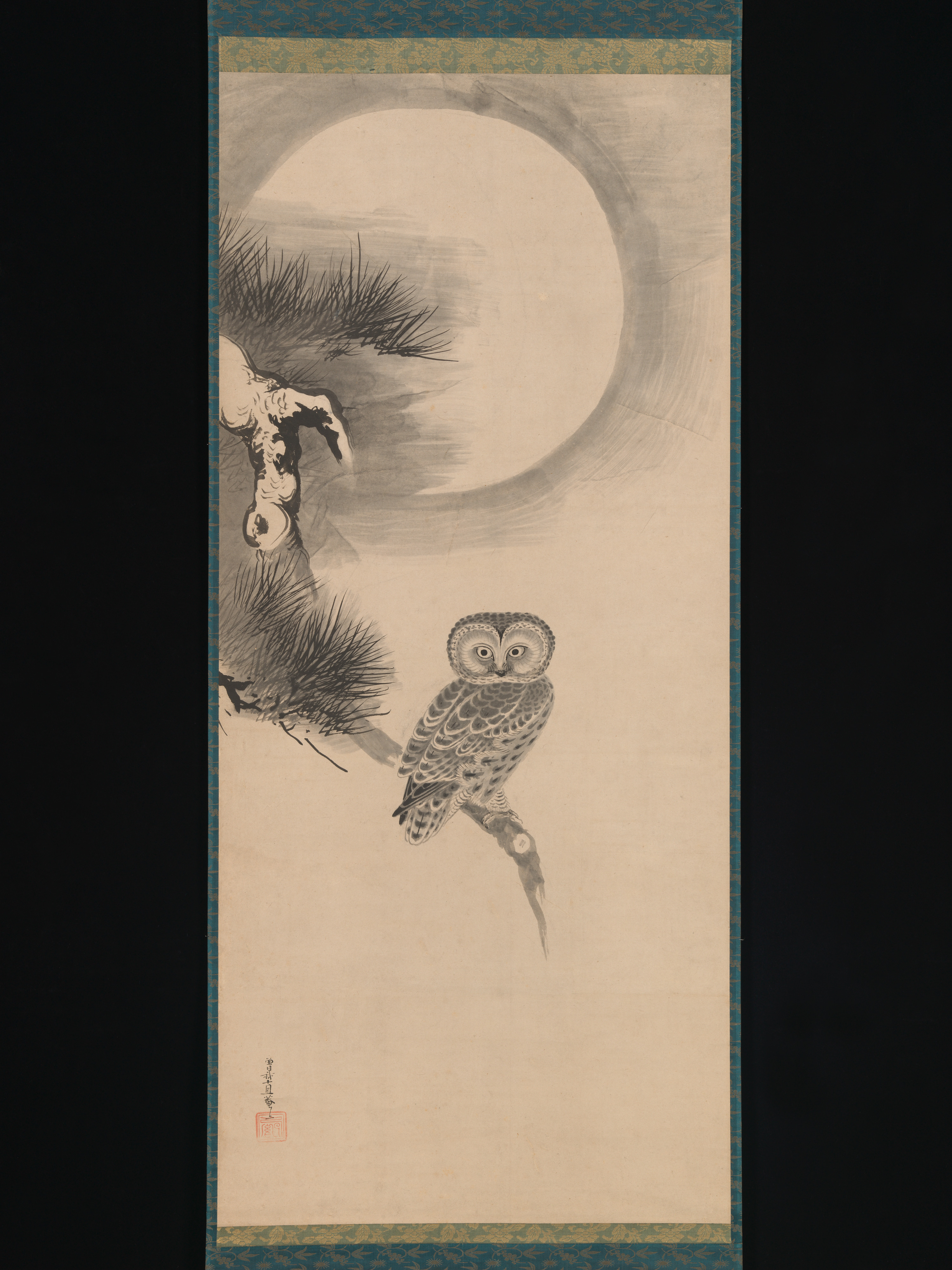
Here lies the line to hold, before any comparison. We, too, make beasts speak—in fables. But in Aesop or La Fontaine, the human poet lends his voice to the animal to speak of man: the crow and the fox are masks, the subject of the tale remains us, and the beast is but a mirror held up to our flaws. The yukar does the opposite. The human falls silent and listens; the animal keeps its voice; and what it says is its own world—its visit, its prank, its death, even the law it leaves to its kin: beware of playing tricks on humans. The mirror has been turned. It is no longer the beast reflecting our image back to us: it is the beast looking at us, and, in looking, choosing to descend and tell its tale. Nichokuan’s owl, on its pine branch beneath the full moon, turns two round eyes toward us. The question is not what it is. It is what it will say when its turn comes to sing “I.”
Sources cited
- Chiri Yukie, Ainu shin'yōshū (Recueil des chants divins ainu), ed. Sarah M. Strong, Ainu Spirits Singing, University of Hawai'i Press, 2011 (manuscrit de 1922), trans. Sarah M. Strong (de l'ainu et du japonais vers l'anglais) ; rendu français maison.
- Donald L. Philippi, Songs of Gods, Songs of Humans: The Epic Tradition of the Ainu, ed. University of Tokyo Press / Princeton University Press, 1979, trans. Donald L. Philippi (regard extérieur) ; rendu français maison.