Enough
Sufficiency is not a quantity. Epicurus measures it by bounding desire; Lao-Tzu simply stops chasing. Two different hands on the same wealth.
Ask anyone how much they would need to be at peace: they will almost always name a little more than what they have. The threshold retreats as one approaches it. The person who believed they had reached it yesterday finds themselves wanting today—not because they possess less, but because the measure has shifted. Two sages, separated by a continent and a few centuries, made the same observation: lack does not reside in things, but in the desire that counts them.
Epicurus writes to a young man, Menoeceus, and begins by dispelling a misunderstanding. He is credited with the cult of pleasure, imagined feasting on rare delicacies; he responds by sorting desires.
Consider also that different things are the object of our wishes and desires: some are natural, others superfluous; some are absolutely necessary by nature, while others, though inspired by nature, can be done without.
The division is finer than a simple distinction between good and bad. Drinking when thirsty, eating when hungry, seeking shelter: these are natural and necessary desires, which nature itself bounds—thirst is quenched, the stomach filled, the need has a limit. Savoring a rare dish is still natural, but one can do without it. Craving wealth, glory, or power over others: these are desires without bounds, for nothing in nature checks them. It is here, and here alone, that lack becomes endless—not for want of enough, but because such desires have no “enough.” Epicurus’s gesture is not one of deprivation: it is to weigh what each desire costs and what it yields in tranquility, then to let go of those that exact an unending anxiety. The same suspicion he casts on the fear of death, he casts on the greedy root of desire: examination dissolves what opinion had magnified.
This little, Epicurus describes without the slightest austerity.
Nature requires for its subsistence only things very easy to find; those that are rare and extraordinary are useless to it, serving only vanity or excess. Plain fare gives as much pleasure as a sumptuous feast, and water and bread are a marvelous repast when one finds them in hunger and thirst.
Whoever grows accustomed to little does not impoverish themselves: they become unassailable. All the help lies in the habit formed—“being accustomed to do without little, whatever abundance it may take away, only returns us to a state it cannot steal.” Sufficiency is not a sacrifice consented to; it is the place where fortune no longer has leverage.
Is sufficiency a form of deprivation?
No. For Epicurus as for Laozi, sufficiency is not a consented lack but the end of lack. The frugal sage has not renounced pleasure: they have ceased to expect it from an endless surplus. To be content with little is to become untouchable by fortune, not to impoverish oneself.
At the other end of the world, Laozi touches the same point, but with a very different hand. He does not sort desires or weigh anything.
There is no greater crime than yielding to desire. There is no greater misfortune than not knowing contentment. There is no greater calamity than the desire to acquire. He who knows contentment is always satisfied with his lot.
“Knowing contentment”—zhī zú: not the result of examination, but an accord with the course of things. The Tao Te Ching does not review desires one by one; it targets a single renunciation, of the very movement of acquisition. “He who knows contentment is rich enough,” says Chapter 33; “he who knows when to stop never perishes,” adds Chapter 44. The evil is not any particular excessive desire, but yielding—letting oneself be carried away in the chase. The remedy, then, is not calculation, but non-action: ceasing to reach out, returning to one’s nature. Where Epicurus measures, Laozi lets go.
Let us not confuse the two gestures. Epicurus sets a limit and holds to it: knowing the boundary, learning it, making it a habit—his frugality is a conquest of reason, a prudence patiently practiced. Laozi sets no limit; he simply withdraws the gesture that demanded one. One regulates appetite through the intelligence of just measure; the other simply lets go of the pursuit. To reduce the Chinese way to a shrewd calculation, or Greek prudence to pure abandonment, would undo them both: measuring assumes evaluation, non-action assumes ceasing to evaluate.
And yet both paths lead to the same word. For both, wealth is not a quantity. “He who knows contentment is rich enough,” says the Chinese; “it is to enjoy a magnificence full of delight to be satisfied without any excess,” says the Greek. The rich are not those who have reached a sum: they are those for whom the threshold no longer recedes. Calculation and letting go are two very different paths, but their summit is one—enough is not an amount, but a relationship to desire where lack no longer governs. One arrives by weighing or by ceasing to weigh; one finds the same peace, which no longer depends on what one possesses.
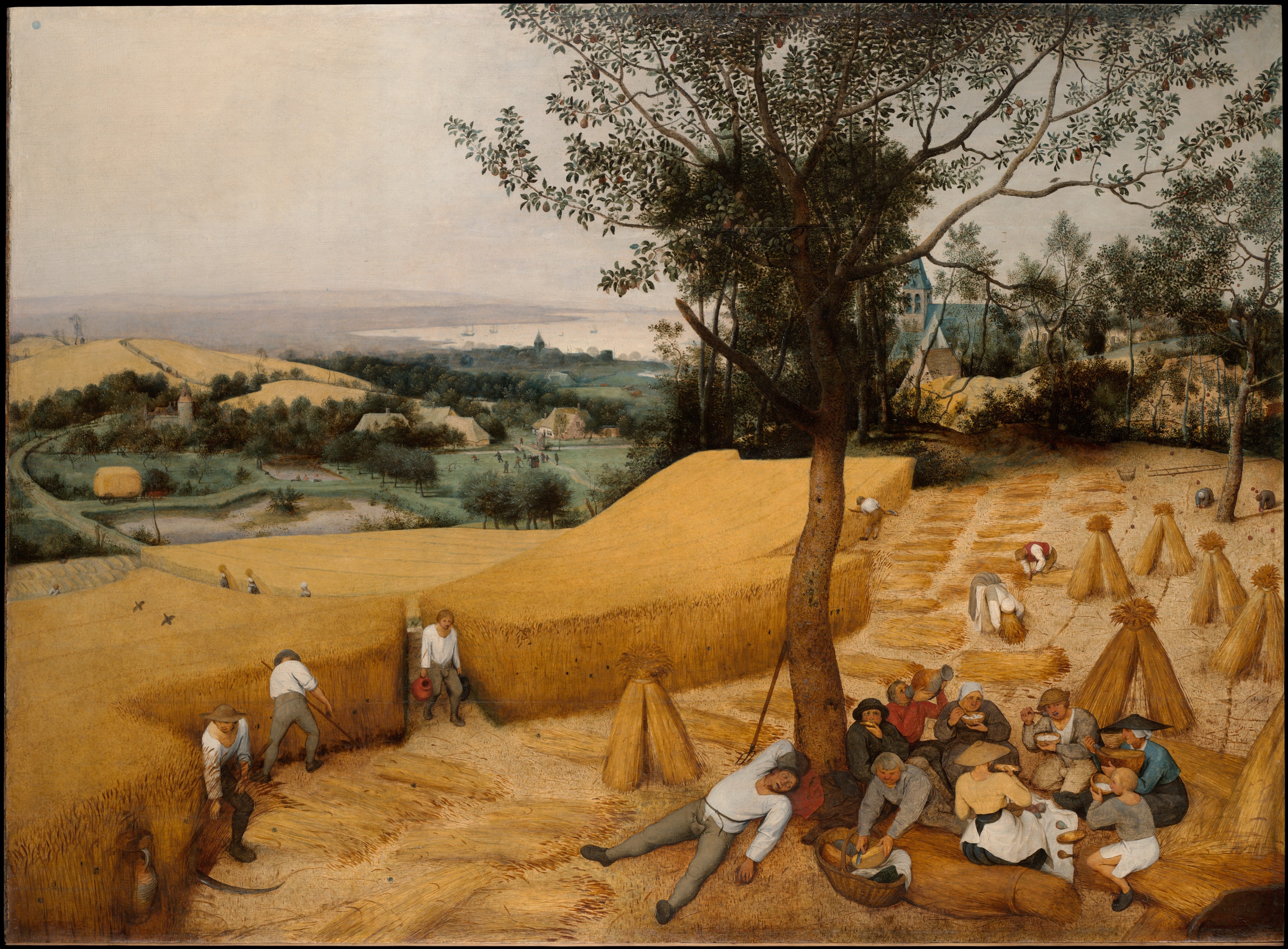
Beneath the tree, in the heat of the day, the harvesters break bread and drink; the field behind them overflows. Nothing in the scene suggests one should have less. It only says that where one knows how to stop, there has long been enough.
Sources cited
- Épicure, Lettre à Ménécée, ed. Lefèvre, 1840, trans. Jacques Georges de Chauffepié.
- Lao-Tseu, Tao Te King, ed. Imprimerie nationale, 1842, trans. Stanislas Julien.