What Force Cannot Endure
Lao-Tzu: the violent wind falls of its own accord, no need to fight it. The Gītā: desire is an insatiable fire, to be cut down. Both reject force as master, yet their gestures diverge.
 A gust of wind bends the trees, makes what juts out snap, stirs the dust from the path; then, before noon, the sky has already forgotten it all. The most brutal squall is also the briefest—as though violence carried within itself the measure of its own end. An ancient text turns this observation of time into a distinction between what endures and what does not.
A swift wind does not last the whole morning; a violent rain does not last the whole day. What produces these two things? Heaven and earth. If even heaven and earth cannot sustain them for long, how much less can man!
The argument moves from the greatest to the smallest, and it disarms. The storm is no mere accident of time: it is the work of heaven and earth, the very powers that shape the world. And these cannot sustain their excess beyond a single morning. If the greatest forces cannot uphold what is violent in them, how long will a human endeavor built on force endure? The point is not a reproach—it does not say violence is evil—but almost a physics: what forces expends, and what expends exhausts itself. The squall does not hold because nothing beneath it renews it; it is all surface, all expenditure.
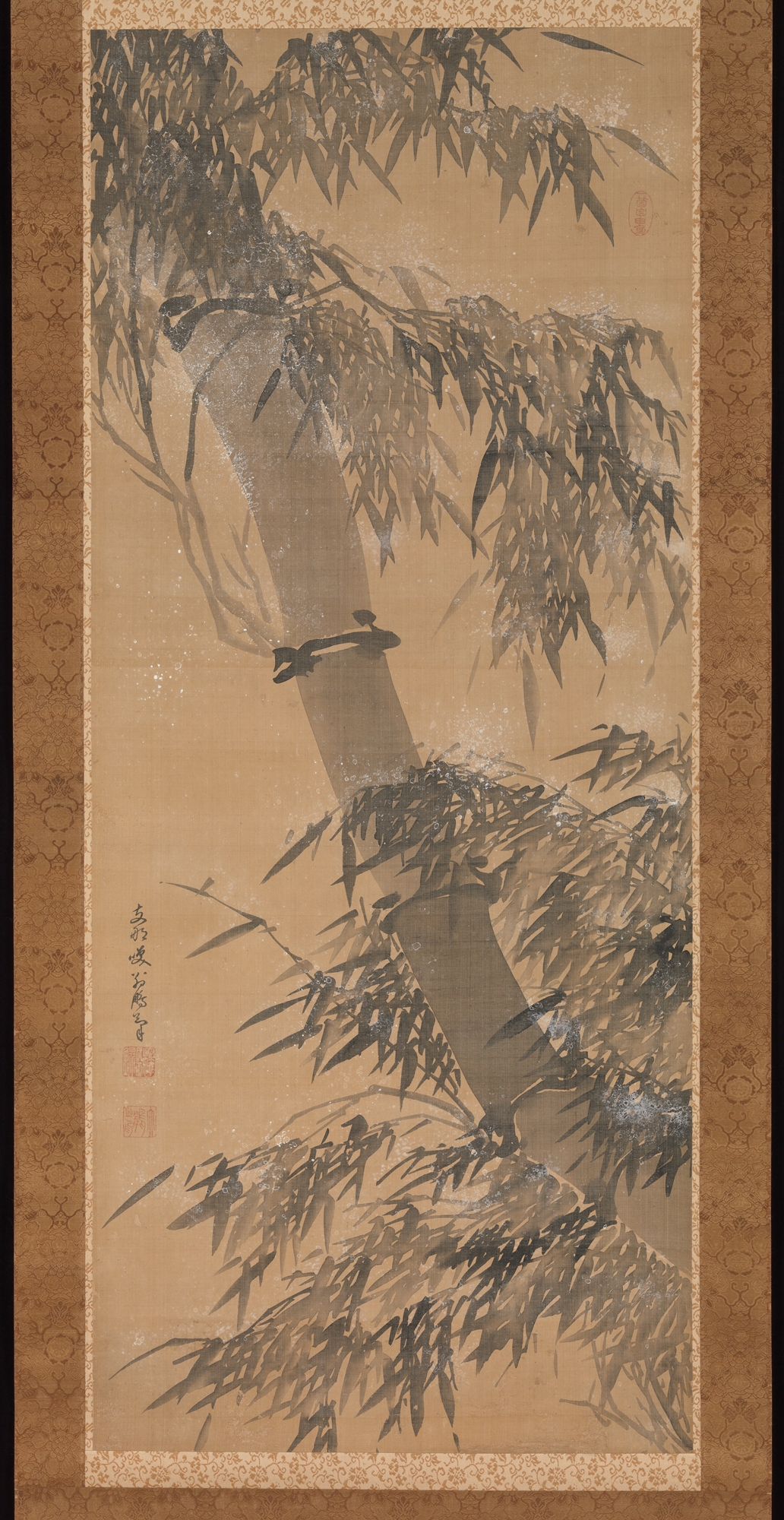
What, then, endures? The chapter’s answer is not “the gentle rather than the violent,” but “what accords rather than what forces.” A few lines later: “if man surrenders to the Tao, he becomes one with the Tao”; and “he who becomes one with the Tao gains the Tao.” Endurance is not conquered; it is accorded. Whoever aligns with the course of things receives its steadiness; whoever braces against it shares the fate of the storm. This is the logic of wu-wei, action that does not force: not abstention, but spending nothing against the current. The bamboo bent under snow does not struggle against the weight; it yields, lets the burden slide, straightens when the white has melted—while the stiff branch, which resisted, lies broken.
Why does violence not endure?
For Laozi, the swift wind and violent rain are the work of heaven and earth themselves—and yet they do not last a morning or a day. Violence expends a force it does not renew: it exhausts itself in its very excess. Only what accords with the way, without resisting it, endures.
Yet there is a violence that does not fall before noon. Under another sky, in an epic where a warrior hesitates on the brink of battle, Arjuna asks Krishna a question that turns the problem inward: “by what is man driven to sin against his will, as if compelled by an alien force?” The answer does not describe a squall, but a fire:
It is love, it is passion, born of Darkness; it is devouring, full of sin; know it as an enemy here below. As smoke veils the flame, as rust tarnishes the mirror, as the womb envelops the fetus, so this fury shrouds the world. The eternal enemy of the wise, it obscures knowledge. Like an insatiable flame, it shifts form at will.
This “alien force” that drives man despite himself is desire—kāma. And everything in Krishna’s portrait contradicts the brevity of the squall. Passion is an “eternal enemy,” “insatiable”; it “shifts form at will”: far from exhausting itself in excess, it feeds on what it devours. The wind falls because nothing sustains it; the fire of desire, however, has roots—the senses, the mind, reason, which it has colonized. Thus the remedy is not to wait for it to pass. The Gītā does not propose letting be, but cutting it down: “bind your senses from the start, and destroy this sinner that steals knowledge”; “steady yourself within, and slay this enemy of shifting forms.”
Here, then, are two violences, and two gestures that do not coincide. Laozi’s is external, cosmic, and self-limiting: the squall stops on its own, and wisdom lies in not adding one’s own force to it—letting the wind fall. The Gītā’s is internal, and knows no measure: desire never ceases on its own, and wisdom becomes a struggle—to sever the fire. To the one, reality offers the storm’s end; to the other, nothing grants it: it must be torn out. Not acting against the squall, acting with all one’s soul against the flame—these are not two names for the same attitude. One does not hold the inner fire with the same letting-go that suffices for the outer wind.
And yet the two perspectives converge at a point neither yields. Neither takes violence as master or measure. What endures, what liberates, both locate beyond force: in accord with the way, or in that “stronger than reason” the Gītā calls the self. Beneath the opposing gestures lies a shared intuition: violence is not at home in reality. Arjuna calls it an “alien force,” come despite oneself; Laozi makes it a surge of heaven that is not heaven’s way. Superadded, without proper dwelling. Hence its fate, on both sides: what is not at home does not endure—whether one lets it fall for lack of roots, or tears it out because it has taken root where it should not. The same exile pronounced against violence; two hands to escort it back out.
It remains to recognize, before what sweeps us away, which violence it is: that which would pass if we ceased to answer it, or that which, lurking beneath us, waits for us to stop believing it will pass.
Sources cited
- Lao-Tseu, Tao Te King, ed. Imprimerie royale, 1842 (Wikisource), trans. Stanislas Julien.
- Krishna (attrib.), Bhagavad-Gîtâ, ed. Librairie de l'Institut, 1861 (Wikisource), trans. Émile Burnouf.