Fascism
An ideology born of a bundle of power, the word has been hollowed out to designate any indistinct oppression. This reversal, first carried out in English, resurfaces wherever the same linguistic gesture has erased political precision in favor of a rhetorical weapon. The map reveals a translinguistic intersection: the same word, the same void.
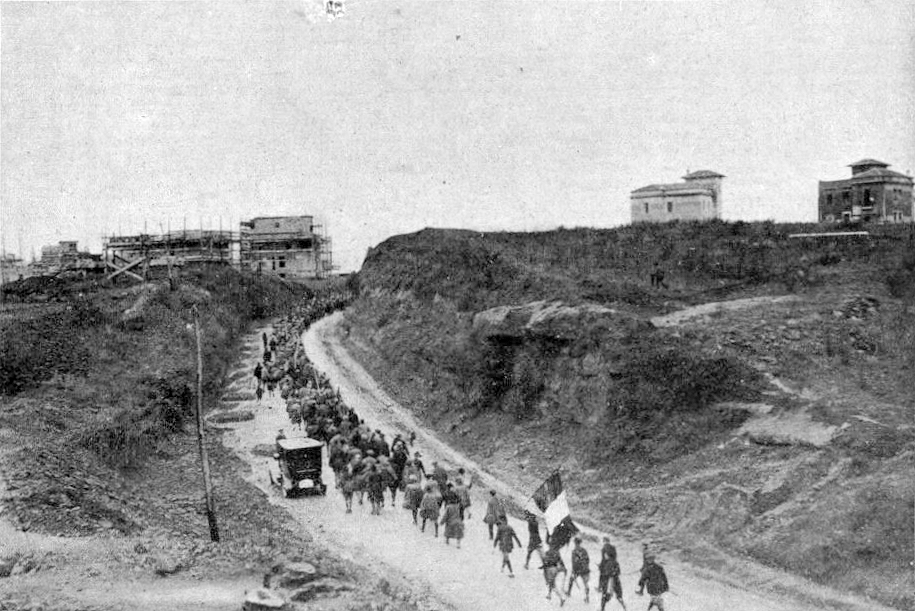
Fascism is rooted in the Roman image of the fasces: a bundle of rods bound together, symbol of unified authority. Born in Italy to designate a specific movement, the word has crossed languages while shedding its historical weight. Its distortion is not the result of natural semantic drift, but of a deliberate operation: draining the term of its substance to turn it into a convenient catch-all. English set the pattern for this shift, yet the map reveals that other languages have replicated the same gesture.
The meaning beneath the word
The word fascism draws its root from the Latin fasces, emblem of the Roman lictors. This bundle of rods, bound by straps and topped with an axe, embodied the unity of executive power. Transposed to Italy in the early 20th century, it first designated the Fascio di Combattimento (1919), then Mussolini’s regime. Its original meaning is thus political and geographical: a structured doctrine, a party, a state. Nothing in this etymology foreshadowed the shift to come.
The genealogy of distortion
The distortion unfolds through a twofold movement: the abusive extension of the term to regimes or practices unrelated to Mussolini’s Italy, followed by its reduction to a generic insult. This process, analyzed in the Anglophone sphere, reveals a strategy of obfuscation.
Since you don’t know what Fascism is, how can you struggle against Fascism?
Orwell’s remark pinpoints the essence of the distortion: by emptying fascism of its precise definition, it is transformed into a convenient bogeyman. The obscured object is no longer an identifiable ideology, but a vague concept, deployable against any adversary. The word becomes a rhetorical weapon, its power lying precisely in its imprecision.
The same veil, from one language to another
This shift is not unique to English. Other languages, faced with similar political contexts, have reproduced the same mechanism: draining the word of its substance to turn it into a tool of ideological combat.
| Langue | Forme du mot | Attestation |
|---|---|---|
| French | fascisme | ○ |
| English | fascism | ● |
| German | Faschismus | ○ |
| Spanish | fascismo | ○ |
| Italian | fascismo | ● |
| Russian | фашизм fashizm | ● |
| Turkish | faşizm | ● |
| Chinese | 法西斯主义 fǎxīsī zhǔyì | ○ |
Same nature (hollowing out of meaning) and same object (a precise political ideology) attested by native sources in English, Italian, Russian, and Turkish. Sourcing gap (not an absence) in French, German, Spanish, and Chinese.
attesté par un dévoileur natif · lacune (non encore sourcé) — jamais « absent »
In Italian, the word fascismo has followed an inverse trajectory: born as a banner, it became a repellent.
Parents are opposed to fascism; yet their criticism of the regime tends to blur into a general condemnation of politics.
The source shows how, after the regime’s fall, the term was stripped of its historical content to designate any form of authoritarianism, thus losing its Italian specificity.
In Russian, фашизм (fashizm) met a similar fate.
as an enemy more dangerous than imperialism and fascism.
The word, imported to designate German Nazism, was extended to any enemy of the Soviet regime. This expansion erased the differences between ideologies, retaining only a convenient label applied to regimes or groups with no connection to historical fascism.
Finally, in Turkish, faşizm illustrates the same phenomenon.
In our time, the abolition of the right to provoke (which the state deems unacceptable in its citizens) is a demand against the lynch regime, against the loss of civilization inherent in lynching, against the fascist propensity.
The term, borrowed from Italian and then English, was used to stigmatize political opponents, gradually losing its original meaning. The Turkish source reveals how the word became a catch-all, designating any perceived oppression, regardless of its actual nature.
The word and its shadow
Fascism is no longer a system, but a specter. This shift, enacted across several languages, raises a simple question: what remains of a word when its history is stripped away? The answer lies in its usage. The veil is not merely semantic—it is political. And this is precisely what the map of languages reveals: the same gesture, the same strategy, the same silence.
Sources cited
- George Orwell, Politics and the English Language, ed. 1946.
- Italo Calvino, Una pietra sopra (L'antilingua), ed. Einaudi.
- Ilya Zemtsov, Советский политический язык, ed. Overseas Publications, 1985.
- Tanıl Bora, Zamanın Kelimeleri, ed. İletişim, 2018.