The Center Nothing Displaces
The 'firm in wisdom' man of the Gītā withdraws his senses like the tortoise its limbs; Spinoza’s sage withdraws nothing—he understands. Two forms of steadfastness, one center the opposites no longer reach.
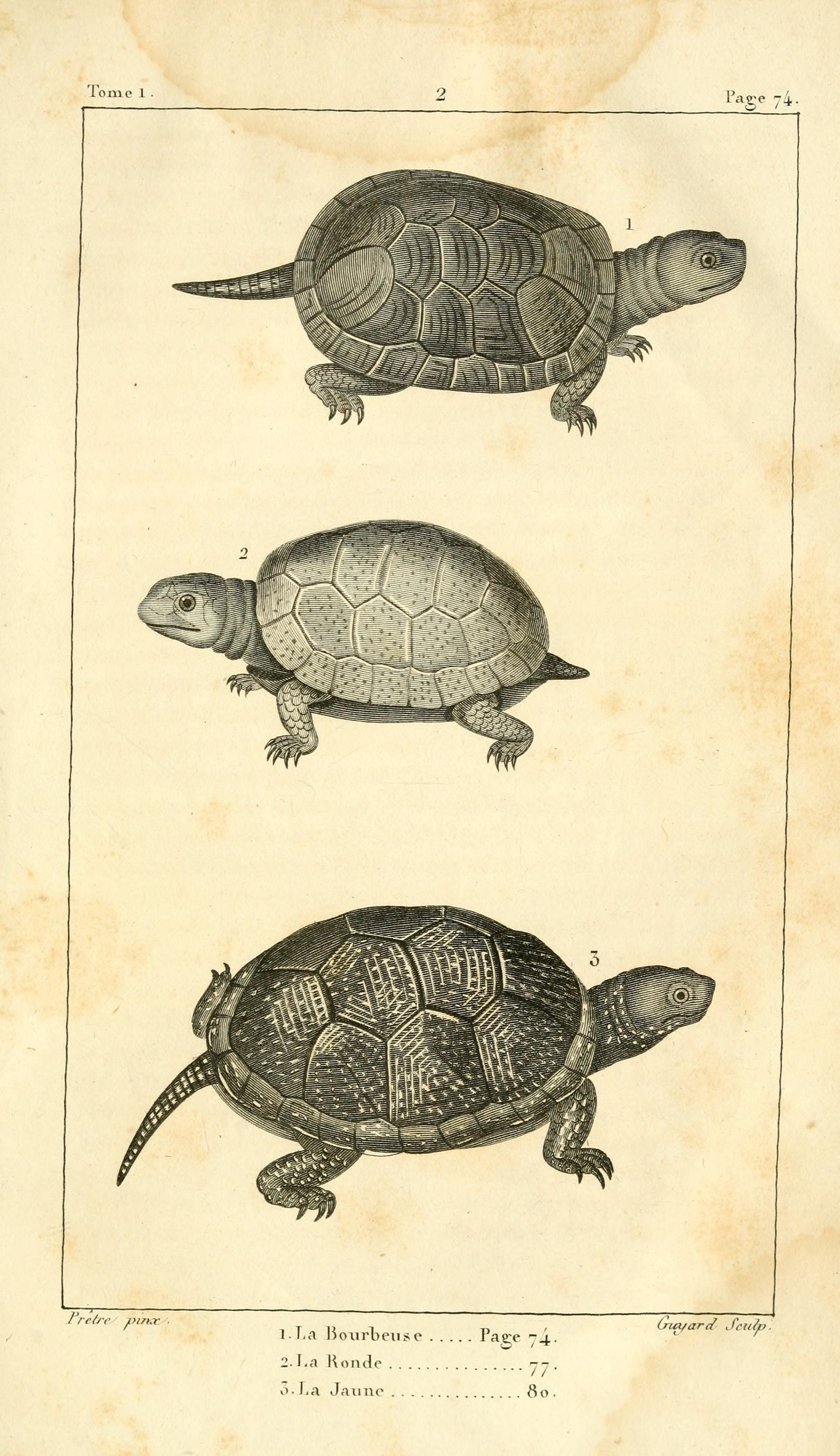
We often imagine the steadfastness of the soul as hardness: a man who arms himself, clenches his teeth, lets nothing touch him. On the battlefield where the Bhagavad-Gītā opens, Arjuna the archer collapses precisely because he has felt everything—the pity, the fear of doing wrong, the disgust for the blood he is about to shed. And he asks Krishna a question no longer that of a warrior but of a disciple: how does one recognize the man “firm in wisdom and firm in contemplation,” who remains “unmoved in thought, whether speaking, resting, or acting”?
Son of Pṛthā, when he renounces all desires that enter the heart, when he is content within himself, then he is said to be firm in wisdom. […] If, like the tortoise drawing in all its limbs, he withdraws his senses from the objects of sense, his wisdom is established.
The answer defies the image of armor. The sage Krishna describes is not a wall; he is a tortoise. The difference lies entirely in the gesture: the wall resists, the tortoise withdraws. It does not break what strikes it; it retracts what could be struck. Its limbs are not severed; they fold inward—and may unfold again. Steadfastness, then, is not rigidity opposed to the world, but a power of recall: drawing the senses back within, like closing a hand. The man “unshaken in adversity, free from joy in success” has “banished love, fear, anger” not by hardening himself, but by ceasing to extend his senses toward what carries them away.
This steadfastness rests on something. The entire second chapter has established it before arriving at the tortoise: beneath the passing bodies, there is a Soul that “neither arrows pierce nor flame burns”—eternal, untouched. It is from there that the sage draws his composure. He does not confront opposites; he has withdrawn to the place they cannot reach. And the movement culminates in an image of water: “Into the unchanging Ocean that ever fills itself, the waters lose themselves: so the man in whom all desires are lost attains peace.” Desire is not fought piece by piece; it is lost, as a river ceases to be a river when it enters the sea. The Gītā calls this end “the divine rest”: the soul that reaches it “has no more troubles.”
Is the sage’s steadfastness a form of insensitivity?
No. Neither the Gītā nor Spinoza describes a deadened heart. The “firm in wisdom” has withdrawn his senses, yet remains “content within himself”; Spinoza’s sage “possesses true contentment.” This is not the absence of emotion, but a foundation: a center the opposites reach without displacing. The tortoise that withdraws has not lost its limbs—it has ceased to let them hang outward.
Two thousand years and a continent apart, Spinoza describes a strikingly similar man: one no longer tossed by fortune. At the end of the Ethics, after traversing the entire mechanics of the passions, he contrasts the ignorant man “driven in many ways by external causes” with another figure.
The sage, on the other hand, considered in this capacity, is scarcely troubled within, but being, by a certain eternal necessity, conscious of himself, of God, and of things, never ceases to be, and possesses true contentment.
The portrait converges; the path diverges entirely. For Spinoza withdraws nothing. His steadfastness is not achieved by subtracting the senses, but by understanding: the power of the soul, for him, lies entirely “in the knowledge alone that is in it.” The Spinozist sage remains turned toward the world, senses open; what changes is not the quantity of world entering him, but the quality of the ideas he forms of it. The more he conceives things as flowing from a single eternal necessity, the less affections shake him. And he explicitly reverses the order the tortoise suggested:
Beatitude is not the reward of virtue, but virtue itself; and this flourishing is not obtained by the reduction of our sensual appetites, but it is this flourishing that makes possible the reduction of our sensual appetites.
Here lies the dividing line, sharp before any comparison. The Gītā moves from subtraction toward peace: withdraw your senses first, renounce desire, and wisdom will be established. Spinoza takes the opposite path: it is not by first repressing appetites that one becomes serene, but serenity—understanding become power—that then allows their reduction. One withdraws inward and closes the door; the other opens it wider and lets in the entire necessity of things. One extinguishes desire; the other transmutes it by understanding it. Even their horizons differ: the Gītā’s rest is an extinction, the soul “going out in God”; Spinoza’s beatitude is an activity that does not cease, a mind that “never ceases to be” in the love of what it knows. To reduce one to the other would undo both.
And yet they name the same point. Whether one arrives by withdrawing the senses or expanding the intellect, one reaches the same center, which opposites touch without moving: “Hold pleasure and pain, gain and loss, victory and defeat as equal,” teaches the Gītā; Spinoza’s sage, for his part, “is scarcely troubled within.” And neither grounds this immobility in a hardening of the small self: both root it in something vaster—the eternal Soul that nothing pierces, the eternal necessity of God. The same water serves as their image: the Gītā sees desires lost in man as rivers in the sea; and Spinoza’s sage is that ocean floor the surface storms reach without stirring. Two paths—one by withdrawal, the other by excess—toward a single water no longer troubled. Both, finally, warn that the place is rare: “the divine rest,” says the Gītā; “all that is beautiful is as difficult as it is rare,” concludes Spinoza. One summit, two slopes one must not confuse.
The steadfastness they propose is not a rampart raised against what comes. It is a depth the world does not touch. Whether one descends by closing the senses or by understanding them, the sign is the same: the waves keep coming, and carry nothing away.
Sources cited
- Bhagavad-Gîtâ, Bhagavad-Gîtâ, ed. Librairie de l'Institut, 1861, trans. Émile Burnouf.
- Baruch Spinoza, Éthique, ed. Garnier Frères, 1913, trans. Charles Appuhn.