Born Under the Yoke
La Boétie holds custom as the first reason for servitude; Epictetus locates freedom solely in what depends on us; Zhuangzi sees in the yoke itself a violence done to nature. Three ways of untangling the instituted from the natural.
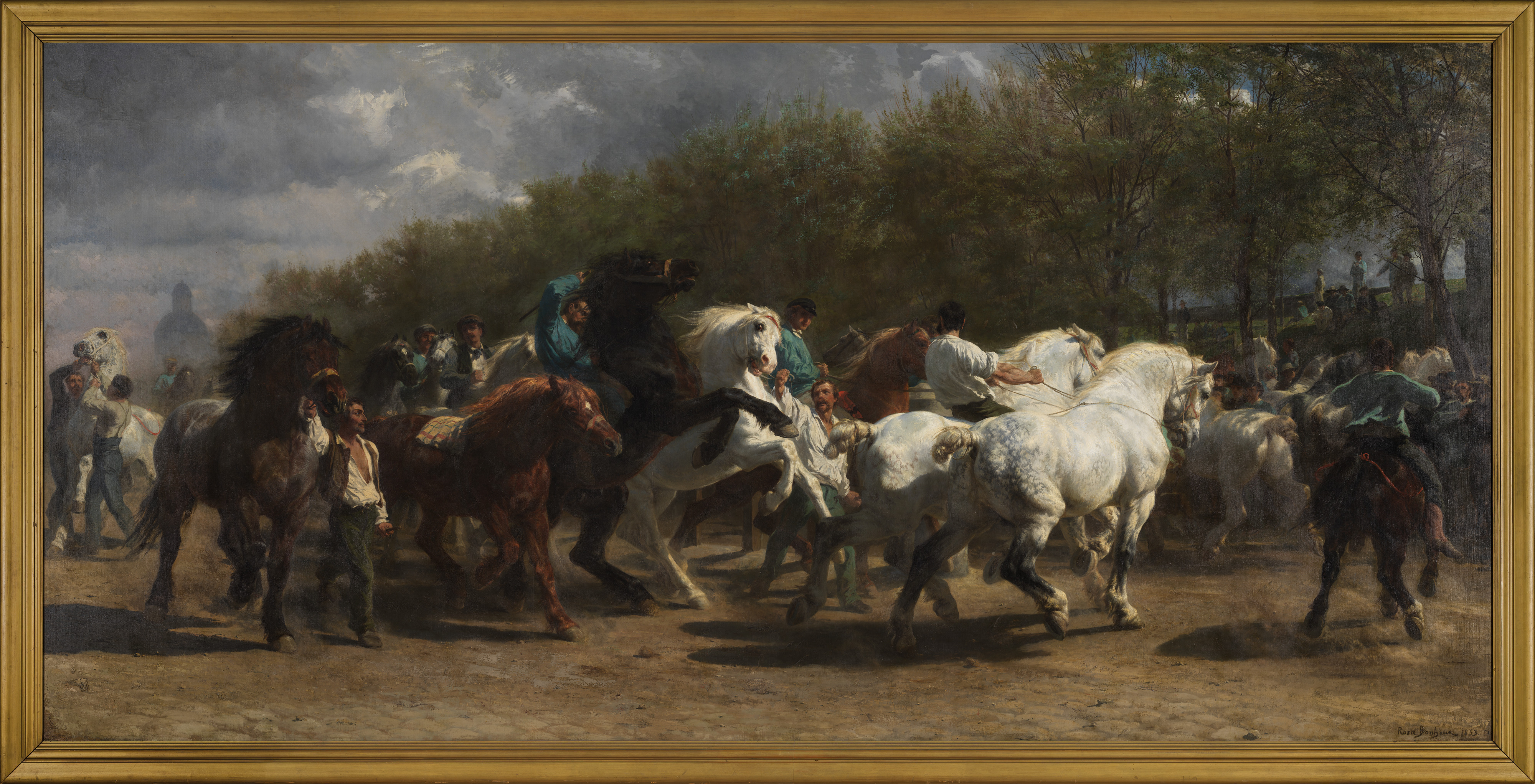
Nothing seems more natural than the order into which we are born. The rank we hold, the obedience we render, the needs we believe we feel—all this preceded us, was there before we could name it, and we do not remember having learned it. What we do not recall having begun, we take for a foundation, for the way things are—not the way they were made. The crease left by habit then passes for a trait of nature; what power, convention, or training has deposited in us, we carry as though it sprang from our very fabric.
Three thoughts, born centuries and worlds apart, have refused this evidence—but not with the same hand, nor to the same depth. A young magistrate from Périgord asks how an entire people consents to bear a single man. A former slave turned master of wisdom draws, between what is ours and what is not, a boundary no tyrant can cross. A Chinese scholar looks at a horse just bridled and sees not an animal finally tamed, but a nature undone. Each drives a wedge between the instituted and the natural; but one lodges it in the habit of a people, another in the judgment of a soul, the third in the very gesture that sets the bit. Three distinct incisions, three opposing exits. To conflate them would be to miss them all.
I. La Boétie: Custom, the First Reason for Servitude
The enigma from which La Boétie begins is not that of the tyrant, but of his subjects. That one man should wish to rule is nothing unusual; that a million men, neither conquered nor defeated, should carry him on their shoulders and lend him the hands with which he strikes them—this is what gives him pause. The master’s power is made solely of the obedience rendered to him; he possesses no force of his own. The servitude he describes is voluntary not because it is chosen with a clear heart, but because nothing sustains it but a long assent no one remembers having given.
Whence comes this assent? La Boétie’s answer seeks neither cowardice nor fear: it names habit. Those who serve today are the sons of those who served yesterday; they entered servitude as into a mother tongue, without choosing it, before they could judge it.
It is this: men born under the yoke, then nourished and raised in servitude, without looking further, content themselves with living as they were born, and do not think they have any other good or right than what they have found. They take the state of their birth for their natural condition.
They take the state of their birth for their natural condition. The entire analysis lies in this sentence. Servitude is not first maintained by constraint—constraint acts only at the beginning, upon the first conquered generation—but by this confusion in which the accustomed passes for the innate. One does not regret what one has never had; one does not contest what one takes for the nature of things. La Boétie thus traces the mechanism to its spring and names it without detour.
Let us say, then, that to man all things are as natural to which he is nourished and accustomed; but only that is truly his own to which simple and unaltered nature calls him. Thus the first reason for voluntary servitude is custom.
To distinguish the naïf—that to which “simple and unaltered nature” calls—from all the rest, which is “as natural” only through accustoming: this is the operation. La Boétie does not say that man is born a serf; he says the opposite, that freedom was the first state and that custom has erased it. Thus, however ancient servitude may seem, it remains a dated fact, a crease one has taken and can undo. He illustrates it with a beast broken to harness: “of the bravest steeds, which at first bite the bit and then play with it, and where once they bucked against the saddle, now they prance in their trappings.” The horse proud of its caparison has forgotten that it was put there; servitude rests not on the bit, but on this forgetting.
From this diagnosis follows a remedy of striking sobriety. If the master has no force but that which is lent to him, there is no need to strike him down: it suffices to cease bearing him.
Be resolved no longer to serve, and you are free. I do not ask that you push or shake him, but only that you no longer support him, and you will see him, like a great colossus whose base has been stolen, collapse under his own weight and break.
Deliverance requires neither weapon nor blood, only a “simple will”—but a will shared, for no one can slip free alone from a burden that all sustain together. Here lies La Boétie’s distinct place: the servitude of which he speaks plays out between men, it is collective and political, and it is together that one undoes it. The wedge he drives between the instituted and the natural passes through the thickness of a people: what a multitude has taken for its fate, a multitude can cease to hold as such. The enigma he leaves open—why does this simple will so constantly fail?—must be taken up elsewhere, within a single soul.
II. Epictetus: What Depends on Us
Let us change ground, and the gaze shifts inward by one degree. Epictetus knew servitude not as a political figure but as a condition: he was a slave before he was freed, and his philosophy bears this mark. One might expect from him the language of La Boétie; instead, he proposes another division. Where the Périgourdin seeks how a people ceases to serve, the former slave seeks what, in every man, cannot absolutely be enslaved. His first distinction is not between two states of a people, but between two regions of existence.
Among things, some depend on us, others do not. Those that depend on us are opinion, will, desire, aversion—in a word, whatever is our own work. Those that do not depend on us are the body, possessions, reputation, honors—in a word, whatever is not our own work.
The gesture is one of razor-sharp clarity. The body, possessions, reputation, rank—everything the master can give or take, everything upon which custom and fortune have a hold—Epictetus sets at once outside us, in the domain of what “is not our own work.” And he draws the immediate consequence for the nature of these things: they are servile in themselves, and to believe one possesses them is already to become their slave.
And the things that depend on us are by nature free; no one can hinder them, nothing can obstruct them; but those that do not depend on us are powerless, servile, subject to hindrance, foreign to us.
Freedom, then, is not for Epictetus a state to be regained against a tyrant: it is a place no tyrant can reach. They may chain my body, take my possessions, ruin my name—yet they cannot tear from me my assent, that inner yes or no which remains my work. The only slavery that counts is that which one inflicts upon oneself by treating as one’s own what is not; the only emancipation, in restoring each thing to its proper domain.
But if you believe yours only what is truly yours, and foreign what is indeed foreign, no one will ever compel you to do anything, no one will hinder you; you will blame no one, you will accuse no one.
Here, one must draw a firm distinction, lest all be blurred. La Boétie and Epictetus both speak of servitude, both say it is in part willed; but they do not target the same yoke nor the same exit. For La Boétie, servitude is a relation between men, sustained by habit, and one breaks free from it through a shared refusal to uphold it. For Epictetus, it is a relation of the soul to what it covets, and one breaks free alone, by ceasing to desire what does not depend on oneself. More still: what Epictetus calls freedom—to remain at rest within, whatever befalls the body and possessions—La Boétie might read as the very poison of Mithridates, the accustoming that makes one “find no bitterness in the venom of servitude.” The Stoic would reply that nothing is more misplaced than this suspicion: he does not grow accustomed to the yoke, he declares it foreign, without hold on the only place that is his. It is at the threshold of inner consent that he mounts his guard, where no edict holds sway. Two men who have faced servitude squarely, and who locate freedom at two different levels of being—one in the city, the other in the soul. To choose between them is not to confuse them.
III. Zhuangzi: The Bit Set Upon Nature
A third voice, and the wedge drives deeper still—beneath the people of La Boétie, beneath the soul of Epictetus, down to the very gesture that sets the yoke. Zhuangzi does not ask how to cease serving, nor how to remain free while serving: he looks at the moment when constraint is applied to what, before it, knew neither master nor servitude. And his image is the very one La Boétie had used—the horse—but turned inside out.
Horses have hooves to tread the snow, coats to shield them from the wind. They graze on grass, drink from streams, run and leap. Such is their true nature. They have no need of palaces or stables. […] When Pai-lao, the first master of horses, taught men to brand, to shear, to shoe, to bridle, to hobble, to pen these poor creatures, then two or three out of ten died prematurely, from the violence done to their nature.
For La Boétie, the horse ended by “prancing in its trappings”: habit made the yoke not only bearable but beloved, until the harnessed beast became the proud accomplice of its constraint. Zhuangzi sees something else entirely. The bridled horse does not grow proud: it is corrupted.
Long ago, in the state of nature, horses grazed on grass and drank from streams. When content, they rubbed necks together. When angry, they turned and kicked. Knowing no more than this, they were perfectly simple and natural. But when Pai-lao harnessed and bridled them, they became cunning and deceitful, out of hatred for the bit and bridle.
The shift is decisive, and worth pausing over. La Boétie and Epictetus still worked within the human order: one sought to undo a relation of domination, the other to render himself invulnerable to it—but both took for granted that there are masters, serfs, possessions to claim or declare foreign. Zhuangzi goes further back. What he contests is not this or that servitude, but the very gesture that divides and shapes—that of the first master of horses upon the horse, and, in the same motion, that of the first Sage upon men. For in his account, the two are one: no sooner has the Sage taught “ritual bows” and “benevolence and righteousness” than “competitions for knowledge and wealth begin.” The rule that claims to elevate debases; the distinction that claims to order divides.
Fortunately, they were then ignorant of the distinction later made so famous by Confucius, between the Sage and the vulgar. Equally devoid of knowledge, men all acted according to their nature.
Here lies the deepest incision. Where La Boétie opposes free nature to servile custom, and Epictetus the proper domain to the foreign, Zhuangzi suspects the very act of division—superior and inferior, sage and vulgar, precious and base—of being the first of all harnesses. Servitude does not begin when one man dominates another; it begins when one introduces the scale that allows them to be ranked. Thus his remedy is neither the will of La Boétie nor the vigilance of Epictetus, but an un-doing: to return to a time before categories, to let be what is as the horse was before the bit, not to force the grain of things. Not to conquer freedom, nor to preserve it: never to have left it.
What We Take for Nature
Three wedges, three depths, three exits. It would be easy, and false, to merge them into a single wisdom of freedom. They do not agree on what servitude is, nor on where one escapes it. La Boétie locates it in a relation between men sustained by habit, and one breaks free together, through a concerted refusal. Epictetus locates it in the desire of a soul for what does not depend on it, and one breaks free alone, by drawing an inner boundary aright. Zhuangzi locates it in the very gesture that shapes and divides, and one breaks free from beneath, by unlearning distinctions. Their exits nearly contradict one another: the first calls for a common will, the second for a solitary discipline, the third for the abandonment of all training—including, perhaps, that of will and discipline. To adopt all three at once would be to hold nothing.
And yet, beneath these disagreements, the same gesture runs through, and it strikes directly at the initial evidence. All three refuse to take the instituted for the natural. What we carry as a foundation—the place where we serve, the attachment to what can be taken from us, the scale that ranks beings—none of the three grants to nature. La Boétie sees in it a crease of custom; Epictetus, a misapprehension of what is ours; Zhuangzi, an incision upon undyed silk. Each, in his own way, unravels the same confusion: what holds us is not in the nature of things, but in a second nature deposited by power, convention, or artifice, and which we have ceased to distinguish from the first. The yoke passes for bone; it is but a strap.
This is the meaning of their shared insistence on the natural—a word none takes in the same sense, yet which, for all, serves the same cutting edge. It does not designate a lost paradise to restore, nor a program to follow. It designates an operation of sight: to learn to see the seam where habit shows only a smooth surface. For what has been made can be unmade, and what was deposited one day is not the last word. To suspend the word that usage puts in our mouths—“natural,” “necessary,” “thus the world goes”—is already to loosen by one notch the strap it conceals.
The image remains, older than the three arguments and shared by two of them: the horse and the bit. One looked at it adorned in its harness, proud, docile, attuned to its burden, and thought it was made for this. It was not. The bit is not in its mouth by nature; someone put it there, one day, and the colt before it ran on the snow without knowing it. The whole question—La Boétie’s, Epictetus’s, Zhuangzi’s, and the one they leave us—lies in the power to remember there was a time without a bit, and no longer to confuse the strap with the jaw.
Sources cited
- Étienne de La Boétie, Discours de la servitude volontaire, ed. texte établi par Paul Bonnefon, Bossard, 1922 (Wikisource), trans. —.
- Épictète, Manuel, ed. Ch. Delagrave, 1875 (Wikisource), trans. Jean-Marie Guyau.
- Tchouang-Tseu, Œuvre de Tchoang-tzeu, ch. IX (Chevaux dressés), ed. Les Pères jésuites de Sienhsien, 1913 (Wikisource), trans. Léon Wieger.