Man and Time: Distension, Illusion, Catastrophe
Three voices on the nature of time before any convergence
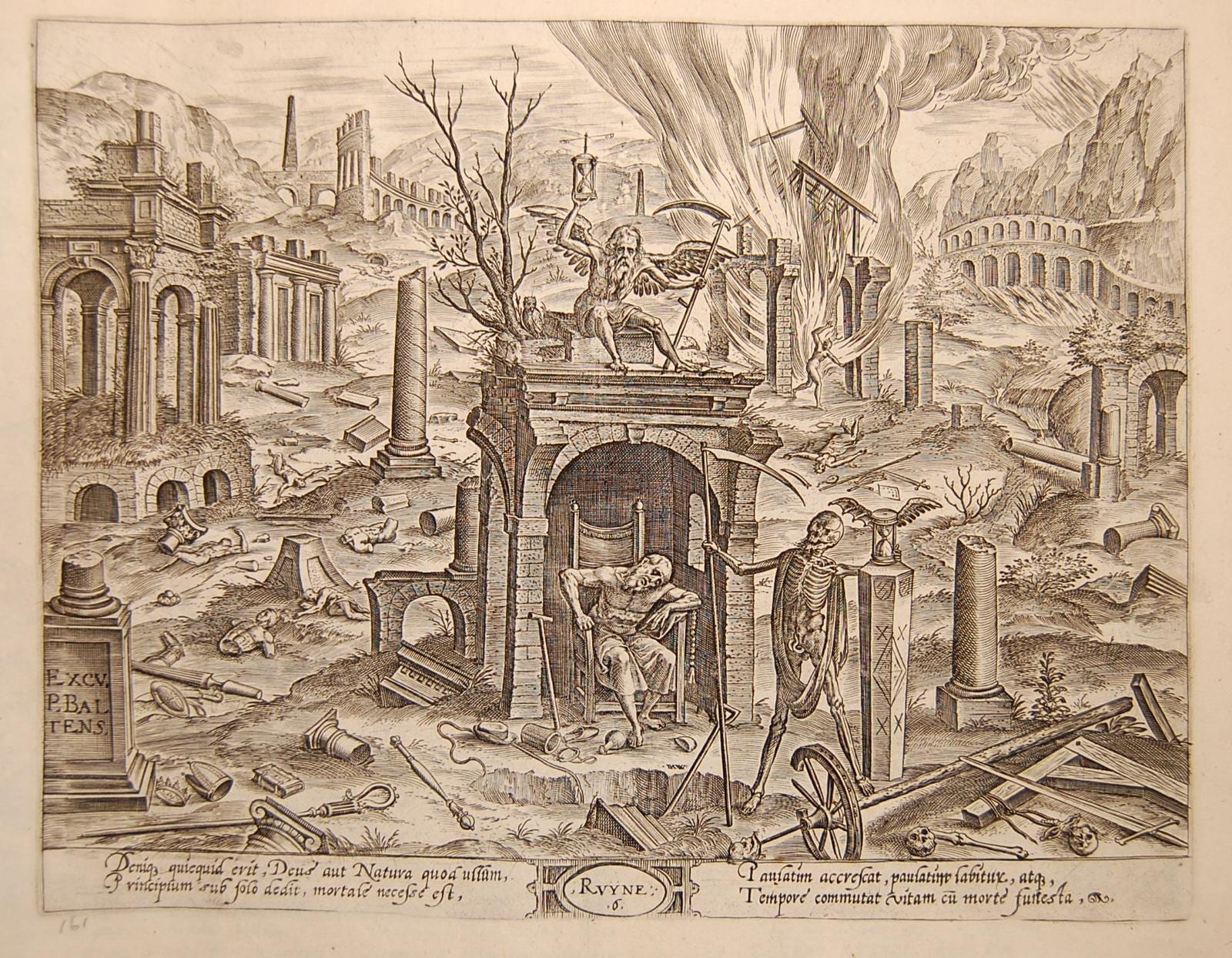
The question of time is not one riddle among others. It strikes at the very being of man—at his way of being present to the world, of remembering, anticipating, or despairing. Three voices, three propositions that do not answer one another, but clash in the silence of their presuppositions. Augustine of Hippo, the Upaniṣads, and Günther Anders share neither language, nor horizon, nor even a minimal definition of time. Their only unity lies in this tension: time is what divides man from himself, whether through the Fall, ignorance, or technology. Before any attempt at synthesis—always illusory—we must hear them separately, in their radicality.
Augustine: Time as the Distension of the Soul in Waiting
For Augustine, time is not an objective measure, but a passion of the soul. It exists only where man stretches toward what is not yet, or turns back toward what is no more. The present, for its part, is always already fleeting, elusive—except in divine eternity, where all is simultaneous. The famous analysis in Book XI of the Confessions does not describe time as a cosmic given, but as a wound: that of the creature severed from its creator, condemned to measure intervals that have reality only in its own memory and expectation.
If I have not the strength to discover the answer, at least I know that wherever they are, they are not there as future or past, but as present.
This sentence, often read as a metaphysical assertion, is first and foremost a confession of powerlessness. Augustine does not claim to define time, but only to observe its absence of reality outside the soul that lives it. The future and the past exist only as present in the mind: the future as expectation, the past as memory, and the present as that infinitesimal moment when one tips into the other. This distension (distentio animi) is not a property of time, but a disease of the soul, a consequence of the Fall. Before original sin, man lived in an eternal present, without this split between what was and what will be. Time, then, is less a structure of reality than an experience of finitude—and of eschatological waiting.
Augustine does not offer a theory of time, but a phenomenology of expectation. Time is not what passes, but what is lacking. The future is not an objective dimension, but that toward which the soul strains in hope (or fear). The past is not an archive, but what the soul holds in memory, like an open wound. And the present? It is that vanishing point where man, unable to grasp eternity, consumes himself in the instant. The question is not what time is, but how the soul lives it—and how, by grace, it may transcend it.
The Upaniṣads: Time as Cyclical Illusion and the Eternal Present
Where Augustine sees a painful distension, the Upaniṣads affirm an illusion. For the śruti, time is not a reality, but a veil (māyā) that conceals the eternal present of Brahman. There is neither future nor past, only ignorance (avidyā) that projects these categories onto reality. The world of appearances (saṃsāra) is an endless cycle, where souls wander from rebirth to rebirth, prisoners of their acts (karma). But this circularity is not a fatality: it can be broken by knowledge (jñāna), which reveals the unity of the self (ātman) and the ultimate principle.
109 he denies, they say), “ Heat the hatchet for him.” If he committed the theft, then he makes himself to be what he is not.
This passage, drawn from a ritual context, illustrates the logic of non-duality (advaita). The thief who denies his crime fashions a false identity—just as man, who believes in time, fashions an illusory reality. Time is not a structure of the world, but a mental construction, a way of slicing reality into sequences to make it intelligible. But this intelligibility is a prison: it keeps the soul in the cycle of rebirths, where each instant is both repetition and anticipation.
The Upaniṣads do not deny the experience of time (aging, the succession of days), but they challenge its ultimate reality. Time is only a mode of perception, like color or sound. The sage who attains knowledge (vidyā) sees beyond this illusion: he realizes that the present is eternal, that the self is identical to Brahman, and that the categories of past and future are but projections of ignorance. The circularity of time is not a fatality, but a trap—and liberation (mokṣa) consists in breaking free from it.
Unlike Augustine, the Upaniṣads do not see time as a consequence of the Fall, but as a misapprehension. Time is not a wound, but a mistake. There is no eschatological waiting, for eternity is not to come: it is already here, hidden beneath appearances. The question is not how to live time, but how to see it for what it is: a necessary fiction, but one that can be overcome.
Günther Anders: Time as Technological Catastrophe
With Anders, time is no longer a distension of the soul nor a metaphysical illusion, but a catastrophe. In Die Antiquiertheit des Menschen, he describes a perpetually obsolete present, where man, outpaced by his own creations, lives in a state of permanent dissonance. Time is no longer a question of memory or knowledge, but of survival: man has become too slow for the world he has built, and this gap is a form of collapse.
I)IES ME NZ m Be ac TI ELROT EA Aid ET RT ZN its sim ) IR ARE 4f Heitplere l sulleirtu lit: nd & F” u } g.
This fragment, deliberately illegible in its raw form, mirrors the very obsolescence it describes. Anders does not speak of time as a structure, but as a concrete experience: that of a present that constantly eludes, where technical objects become obsolete before they are even understood, where generations are separated by chasms of comprehension. Time, here, is not a philosophical question, but a technical one: it is what accelerates until it renders man superfluous.
For Anders, time is no longer cyclical (as in the Upaniṣads) nor distended (as in Augustine), but torn. Man lives in a present that has no duration, where each instant is already surpassed by the speed of machines. This is not an illusion, but a material reality: technical objects (the atomic bomb, television, factories) have their own temporality, which has nothing to do with man’s. Time is no longer a question of perception, but of power: that of machines over man, that of obsolescence over duration.
Anders offers no solution, only a diagnosis: man has become an antiquarian of himself, unable to keep pace with his own inventions. Time is no longer a dimension to inhabit, but a force that overwhelms and crushes him. The question is no longer how to understand time, but how to resist its collapse.
Convergence: Time as the Space of Finitude
These three voices do not converge. They share neither language, nor method, nor even a minimal definition of time. Yet they sketch a common space: that of finitude. Whether time is a distension of the soul, a cyclical illusion, or a technological catastrophe, it is always what exceeds man, what divides him from himself.
For Augustine, finitude is a wound: time is what separates man from God, and eschatological waiting is the only way out. For the Upaniṣads, finitude is a misapprehension: time is but a veil, and knowledge allows one to pierce it. For Anders, finitude is a catastrophe: time is what crushes man beneath the weight of his own creations.
No synthesis is possible. But in this very tension, something is revealed: time is not an object of knowledge, but a place where man struggles with his own limit. Whether this limit is religious (Augustine), metaphysical (Upaniṣads), or technical (Anders), it is always the same: that of a being who never coincides with himself, and who must, in one way or another, make do.
Sources cited
- Augustin d'Hippone, Confessions, ed. Œuvres complètes, L. Guérin & Cie, 1864 (Wikisource), trans. M. Moreau.
- Upaniṣad (śruti), Upaniṣad, part I — Chandogya (Khandogya), Kena (Talavakara), Aitareya, Kaushitaki, Isa, ed. Sacred Books of the East, vol. I, Oxford, 1879, trans. F. Max Müller (1879).
- Günther Anders, Die Antiquiertheit des Menschen, ed. .