A Single Body
Marcus Aurelius sees the world as one body, the Bhagavad-Gītā the same Self in all beings, Lao Tzu the Principle that nourishes without possessing—three refusals to treat the living as a thing to be taken.
Everything that can be counted, we learn early to take. A tree is tallied in planks, water in megawatts, soil in future harvests; and without thinking, we draw up the world’s inventory as we would a warehouse’s—so many available units, so much to draw from. The gesture seems neutral, almost bookkeeping. Yet it conceals a decision: that things lie there in reserve, separate from one another and from us, set down like objects in a crate from which the hand removes what it needs without consequence. To take presupposes that one can subtract a part without touching the rest—that the pile diminishes indifferently, and that the portion removed was bound to nothing.
This very assumption—three traditions, born far apart and never having read one another—rejected in the same motion. Not out of tenderness for nature, but because they did not see a pile before them. Where we see separate things, one counts the world as a single body, another recognizes the same Self in all beings, the third holds it as what a Principle engenders and nourishes without ever possessing. Three ways of saying that reality is not a stock, and that the act of drawing, which seemed to deplete only a reserve, in truth diminishes something of which we ourselves were part. To confuse them would be a mistake: a Stoic body, a Vedāntic Self, and a Taoist Principle are not three names for the same thing, and each grounds its refusal on a foundation that is not the others’. It is by keeping them distinct first that we may measure what they ultimately share.
I. Marcus Aurelius: One Does Not Take from a Body
The emperor does not reason as a naturalist but as a member. If he refuses to see the world as a collection of detachable parts, it is because he first experiences himself as a part that holds to the others—and the first image that comes to him is not that of a storeroom, but of an organism.
We are all made to work together toward a common end, just as in our body the feet, the hands, the eyes, the rows of our upper and lower teeth cooperate. To act against one another is therefore certainly to go against nature.
The image is no rhetorical flourish; it carries the entire argument. A hand is not a separate part of the body that one could subtract and count apart: it is a hand only so long as it holds to the rest, and severing it does not yield a body plus a hand, but a mutilated body and a dead thing. The limb has neither meaning nor life outside the whole that sustains it. Marcus Aurelius extends this anatomical truth to the dimensions of the cosmos: what the hand is to the body, each being is to the world—not a unit set beside others, but an organ whose very existence consists in cooperating. Thus, “to act against one another,” to take from one’s neighbor as if he were external, is not to exercise a right over an available thing: it is a limb turning against the body on which it lives.
He pushes this intuition to its broadest form. The world is not merely comparable to a body: it is itself a single being, which one must train oneself to see as such.
Continually represent to yourself the world as a single living being, containing one substance and one soul; try to understand how all things relate to a single perception, which is its own; how it accomplishes all through a single impulse; how every detail cooperates reciprocally in all that happens; and finally, how all is interwoven and all is interdependent in the whole of the universe.
All is interwoven and all is interdependent: the phrase undoes in advance the accountant’s gesture. One holds things as a reserve from which to draw only by first believing them unbound—each in its place, without debt to the rest. Marcus Aurelius contests precisely this premise. If all cooperate, then nowhere exists a free part, detachable, that one could claim without disturbing something elsewhere. And the consequence he draws is unyielding: to subtract is a violence done to the whole, and one that recoils.
To remove anything from its interconnection and continuity, whether in the causes that form it or in the parts that compose it, is to mutilate the whole. Now, to the extent that it depends on you, to rebel against its laws is to remove yourself from this whole—and in some way, to destroy it.
There is the exact word, and it is harsh: mutilate. He who treats a parcel of the world as an isolated stock does not merely wrong that parcel; he tears the continuity that bound it to the rest, and, as he himself is of this whole, he severs himself in the same stroke. The taking that believed itself a gain is, in Marcus Aurelius’ accounting, an amputation—and the amputee is also the one who wields the blade. Here one recognizes his constant lesson: the harm one believes inflicted outside always returns, by the bond that holds the whole, to the very thing one is. His answer to those who see the world as a storehouse is not a softening: it is a correction of sight. He does not ask that one love things more; he asks that one cease to see them as separate, because they are not.
II. The Bhagavad-Gītā: The Same in All
Let us change language and soil. The Stoic spoke of parts that cooperate; the Gītā goes further, and the leap is metaphysical. Where Marcus Aurelius saw distinct members of a single body, the Indian poem sees, beneath the multitude of beings, only one reality—not several interdependent parts, but the same Self, identically present in each. The sage is defined by what he sees.
He sees the Self dwelling in all living beings, and in the Self all these beings, when his own soul is united in divine Union and he sees identity everywhere.
The decisive word is identity. It is no longer a matter of saying that beings hold together, respond to one another, depend on one another—that, the Stoic already said. It is a matter of saying that, at bottom, they are the same: a single Self resides in all, and he who sees it in one sees it in all. The separation presupposed by the act of taking—me here, the thing there, available—is not merely harmful, as in Marcus Aurelius; for the Gītā, it is an error of vision, a misrecognition of what is. One does not draw from another than oneself, because there is no other than oneself at the deepest level.
From this vision follows a consequence that directly touches the act of taking. If the same is in all, then the suffering I cause elsewhere is not the suffering of another: it is my own, felt in another place. The accomplished yogī is precisely he who can no longer trace the convenient boundary between what concerns him and what does not.
He, Arjuna, who, instructed by his own identity, sees Identity everywhere, whether happy or unhappy, is an excellent Yogī.
Happy or unhappy: the measure is severe. To see identity everywhere is not an occasional softening; it is to feel it even where it costs—the joy of another as one’s own, but also their pain. For one who sees thus, the living can no longer figure in the column of resources, for that column presupposes that one can set aside what one does not take into account. The Gītā closes this escape: one keeps at a distance, in reserve, indifferent, only what one believes other than oneself—and there is nothing of the kind. It does not ground regard in a duty toward the distant; it dissolves the distant. Its refusal of the world-as-stock is not a morality added to a vision of reality: it is that vision itself, the center where one stands when one has ceased to take oneself for a thing among things.
Yet one must guard against confusing it with Marcus Aurelius. The Stoic maintains plurality—real, distinct members that cooperate within a body; his solidarity is that of parts that remain parts. The Gītā, however, relativizes plurality in favor of the one: separate beings are the surface, the unique Self is the foundation. One says you hold together; the other, you are the same. These are not two degrees of the same thesis, but two foundations: the Stoic cosmic city remains peopled with individuals, the Gītā’s Self traverses them all with a single presence. To merge them would be to lose what each has of its edge.
III. Lao Tzu: Nourishing Without Possessing
A third voice, and the tone shifts again. Neither articulated body nor unique Self: the Taoist does not first describe the structure of reality, but observes the way the Principle behaves toward beings. And what he sees there is precisely the opposite of the act of taking—a generosity that gives all and retains nothing, that produces without claiming what it produces.
Chinese 衣養萬物而不為主
English It loves and nourishes all beings, yet does not regard itself as their master.
Everything lies in that does not regard itself as their master. The Tao gives life to the multitude of beings—it “loves and nourishes” them—yet places no proprietary hand upon them; it does not count them, does not claim them, does not stand above them as one stands above livestock. The most fertile source is here the least possessive: it gives freely without holding anything. The same gesture returns, more expansively, where Lao Tzu describes the virtue he calls profound.
It produces beings and nourishes them. It produces them and does not regard them as its property. It does them good and does not count on them. It rules over them and does not treat them as its master. This is what is called possessing a profound virtue.
The shift, compared to the first two voices, deserves attention, for it is real. Marcus Aurelius and the Gītā spoke of what the world is—a body, a Self—and derived from this being the condemnation of taking. Lao Tzu, however, first shows a conduct: that of the Principle, which brings forth without appropriating. His lesson for man is not “understand that all is one,” but “hold yourself toward beings as the Tao does”—make, nourish, let be, and do not lay the master’s hand on what you need not possess. It is an ethic of imitation, not of knowledge: the Taoist sage does not deduce his restraint from a metaphysics of unity, but aligns it with the non-possessive turn of the Way. Where the act of taking seeks to hold everything, he opposes an action that neither forces nor grasps, an open hand rather than a grasping one.
Let us distinguish firmly, then, before any comparison. The Stoic forbids taking because it mutilates a body of which one is a member; the Vedāntin, because it misrecognizes the Self that is in all; the Taoist, because it betrays the way of a Principle that gives without possessing. Three grounds: the rational order of a body-city, the metaphysical identity of a single Self, the masterless generosity of a source. None can be deduced from the others. To confuse them under the vague term of “wisdom ecology” would be to lose precisely what gives them their force: the diversity of paths by which one arrives at the same threshold.
What Cannot Be Put in Reserve
And yet, that threshold, they reach. Beneath their three languages, the same thing is said, and it strikes directly at the accountant’s initial assumption. All three refuse that one may set the living in reserve—set it apart, hold it as a fund from which the hand draws without consequence. For Marcus Aurelius because there are no free parts in a body, for the Gītā because there is no other than oneself, for Lao Tzu because even the source of all does not make itself owner of anything: by three incommensurable paths, the same premise falls—that which made things into separate units, available, without debt to the rest.
The act of taking seemed to deplete only an indifferent pile. Under these three gazes, it reveals itself otherwise. It presupposes a boundary—me on one side, the thing on the other—which the body of Marcus Aurelius, the Self of the Gītā, and the source of Lao Tzu each undo in their own way. To remove a part believing the rest intact is to mutilate what held together (Marcus Aurelius), to wound what one is oneself without knowing it (the Gītā), to lay the master’s hand where the Way places none (Lao Tzu). The reserve from which one believed to draw was not a storeroom: it was a body, a face, a gift. One does not take from a body as one takes from a pile—and what distinguishes the body from the pile is not its value, but that one cannot remove a part from it without something, elsewhere and even in oneself, responding.
They do not propose, however, that one cease to live from beings; none dreams of a man who would take nothing. The Tao itself nourishes by producing, and the body nourishes through its own exchanges. What they shift is not the fact of receiving from the world, but the way of holding oneself toward it: to receive as a member that gives back what it takes, as a Self that recognizes itself in what it lives from, as a hand that does not grasp. Between drawing from a stock and nourishing oneself from a body of which one is part, there is not a difference of quantity; there are two worlds—and it is the same gesture that, in one, enriches an inventory, and in the other, amputates a continuity.
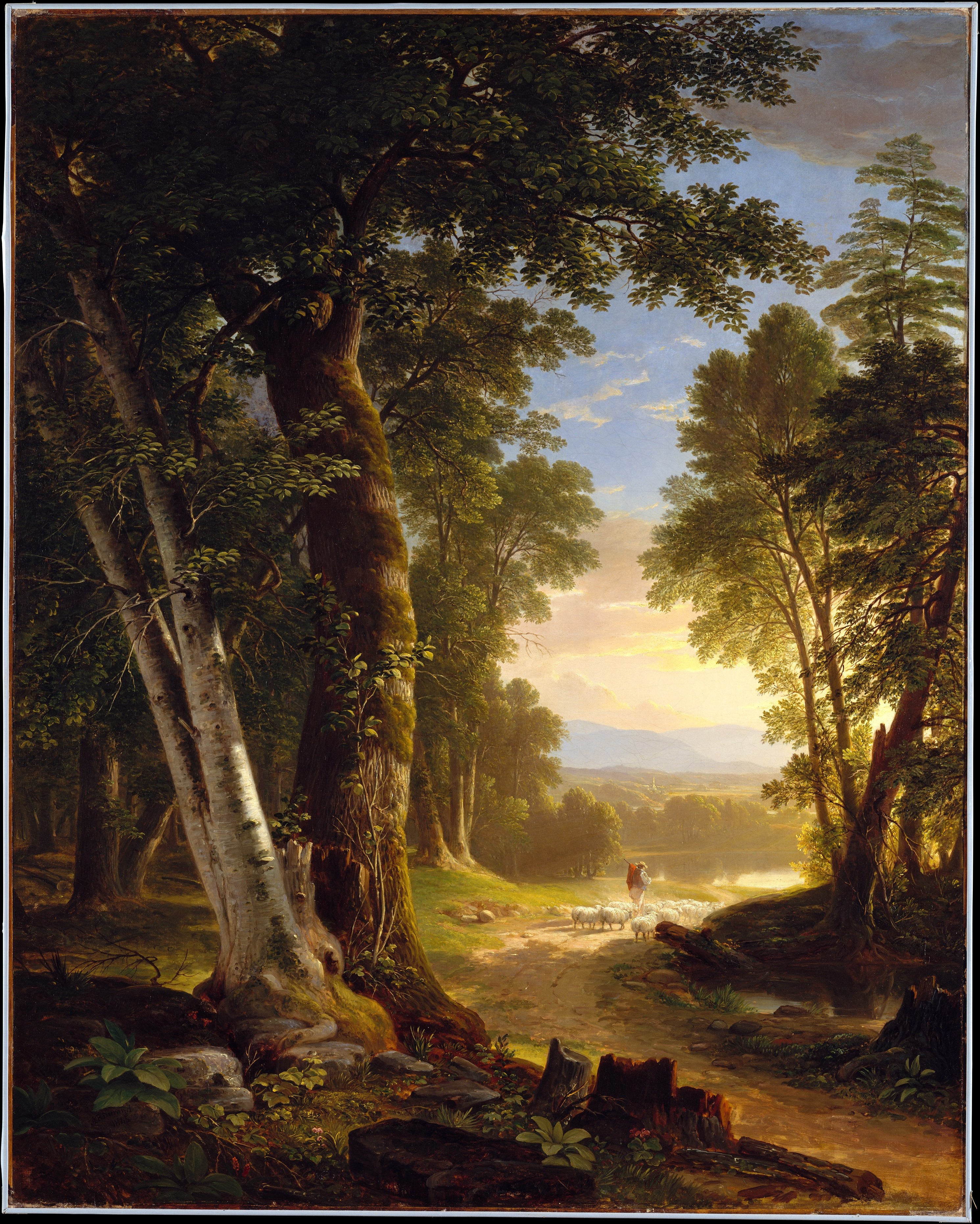
The image remains, older than all arguments. On Durand’s canvas, beeches rise in a quiet light; a single trunk nourishes each branch, and one could not say where the tree ends and the forest begins. Remove a master branch: it is not one branch less, but the tree wounded. The ancients looked upon the world with that eye—not as a lumberyard awaiting planks, but as a living thing of which we are one foliage among others, and which does not belong to us any more than the hand belongs to itself.
Sources cited
- Marc Aurèle, Pensées pour moi-même, ed. Germer-Baillière, 1876 (Wikisource), trans. Jules Barthélemy-Saint-Hilaire.
- Bhagavad-Gîtâ, Bhagavad-Gîtâ, ed. Librairie de l'Institut, 1861 (Wikisource), trans. Émile Burnouf.
- Lao-Tseu, Le Livre de la voie et de la vertu (Tao-te-king), ch. X et XXXIV, ed. Imprimerie nationale, 1842 (Wikisource), trans. Stanislas Julien.