Leisure and the Useless
Aristotle and Zhuangzi before a life that is only worth what it produces—and two opposing doors out of it.
W ith every thing we encounter, a question comes so swiftly we no longer see it coming: what is it for? The tree is appraised in board feet; the hour, in what it yields; and man himself, we learn early to weigh by what he produces. The question seems innocent, almost polite—yet it is already an axe. To ask what a thing is worth for something else is to have decided in advance that it is not worth anything in itself; it is to measure it against an end not its own, and condemn it if it fails to meet that end. An entire life can pass this way, accounting for itself—useful at work, useful to one’s own, useful to tomorrow—without once pausing to ask: what if, at the heart of a life, there were something that need not earn its place?
Two traditions that never met posed this question, two thousand leagues and a century apart, and answered it through two opposing doors. One is Greek, methodical, hierarchical: it seeks, above all labors, the activity that has nothing above it, the one loved for its own sake. The other is Chinese, oblique, playful: it seeks no supreme activity, it deserts the very question of utility, and finds freedom in what serves no purpose. Aristotle ascends; Zhuangzi steps aside. To confuse them under the convenient label of “contemplative wisdom” would be a mistake—they do not contemplate the same thing, and one of them contemplates nothing at all. It is by distinguishing them sharply that we will hear, in the end, what they share beyond all reduction.
I. Aristotle: Leisure Is Not Rest
Aristotle does not despise work; he situates it. Everything we do, he observes, we do for the sake of something else: we heal for health, we fight for victory, we govern for the city. Each act refers to an end beyond itself, and that end to another, and so on—unless somewhere there exists a term that halts the chain: an activity desired for itself and nothing beyond. This is what Aristotle calls happiness, and it is to this that all else, including the noblest labor, serves as an antechamber.
We work only to arrive at leisure; we make war only to obtain peace.
The sentence has the dryness of an axiom, yet it overturns the usual order of values. In common sense, leisure is the interval between two labors—the rest one grants oneself to resume work. Aristotle inverts the relation: it is not leisure that serves work, but work that serves leisure. We do not rest in order to toil better; we toil in order to reach what makes it worthwhile to cease toiling. The word he uses, scholē, designates neither nap nor diversion: it names time freed from necessity, time no longer owed to anyone.
Yet one must not confuse it with relaxation. Aristotle insists: amusement is not happiness, it is only its rest. We amuse ourselves to recover and return to the task—amusement is oriented toward work as sleep is toward waking, it is its repair and not its end. To make play the goal of life would be to toil one’s entire life in order to, at the end, be dazed: an order the child and the tyrant take for wisdom, and which Aristotle holds to be inverted. True leisure is not this respite that recharges the next effort; it is, he says, what is most serious—more serious than the work for which it is the reason.
It remains to be seen what fills this leisure. And here Aristotle parts ways with any apology for idleness. Leisure is not an emptiness to be furnished with pleasures; it is the space reserved for the only activity that suffices—thought turning toward what is, intelligence in act, what he calls contemplation. Why this, and not another? Because it is the only one from which nothing emerges but itself.
This life of thought is the only one loved for itself; for nothing results from this life but knowledge and contemplation, whereas in all things where one must act, one always pursues a result more or less foreign to the action.
There is the criterion, and it is of rare exactingness. Every act that aims at a result “foreign to the action” remains suspended from something other than itself: the just man needs wrongs to right, the brave man a peril, the businessman a profit. Remove the object, the act collapses. Thought alone needs nothing it does not contain: it is to itself its object and its reward. Hence the other trait Aristotle recognizes in it—an independence no other life attains.
The wise man, on the contrary, the scholar can still, being quite alone with himself, devote himself to study and contemplation; and the wiser he is, the more he devotes himself to it. I do not mean that it is not better for him to have companions in his work; but the wise man is nonetheless the most independent of men and the most self-sufficient.
Self-sufficient: the word says it all. The highest activity is that which begs nothing from without, neither matter, nor partner, nor result. Here we recognize, transposed into the order of the mind, the same intuition as that of the sages who made the measure of their desires their wealth—he who knows how to be content is already rich enough. But Aristotle does not speak first of desire: he speaks of the act. His answer to the tyranny of the useful is not to do less, but to do otherwise—to rise, above all labors that yield, to the act that yields only itself. The path out of servile life, for him, ascends. He does not leave the order of activities; he seeks its summit, the point where activity, having ceased to produce, has only to be.
This is to say how much vulgar rest disappoints him. The man who does not know how to inhabit his leisure, who cannot bear to remain alone with his thought and throws himself into noise to flee silence, has not reached scholē: he has only changed occupation. The misery of not being able to remain at rest in a room is exactly the opposite of what Aristotle calls leisure. Leisure is not the absence of activity; it is activity finally freed from the necessity of serving.
II. Zhuangzi: In Praise of the Useless
Change hemispheres, and the tone shifts with the land. Where Aristotle argues like an architect, erecting a ladder of ends, Zhuangzi tells a story about a tree. A logician named Huizi comes to mock him: your discourses, he says, are like a great ailanthus whose gnarled wood is good for nothing and no one wants—vast, and useless. Zhuangzi does not defend himself. He turns the reproach into praise.
So much the better for me, said Master Zhuang. For everything that has a practical use perishes for that very reason. The marten may use a thousand stratagems, but it ends by perishing, its fur being sought after. […] Whereas the ailanthus to which you compare me, growing in barren soil, will grow as large as it pleases, shade the traveler and the sleeper, without any fear of the axe or the adze, precisely because, as you say, it is fit for no use. To be good for nothing—is that not a state one should rather rejoice in?
The reasoning is the exact opposite of the Greek. For Aristotle, the useless was the flaw to be overcome, and contemplation was the highest of activities. For Zhuangzi, utility itself is the peril: what serves is seized. The straight tree that is cut down, the marten hunted for its fur, the horse trained because it bears—everything that answers a use attracts the hand that takes it, and dies of answering. The useless, on the other hand, survives; and it casts, without intending to, the shade that was asked of no one. The same motif returns elsewhere, under the figure of a sacred oak a carpenter disdains:
Yes, trees whose wood is fine are cut down young. From fruit trees, branches are broken in the eagerness to rob them of their fruit. To all, their usefulness is fatal. So I am happy to be useless. […] If you are a useful man, you will not live long.
Yet one would be mistaken to read this as a simple reversal—uselessness put in the place of utility, idleness crowned. Zhuangzi does not propose to become good for nothing as one would aim for a new occupation. What he contests is not this use in favor of that, but the empire of the question “what for?” over every living thing. To ask of a being what it serves is already to hold it at the edge of the carpenter’s axe—to reduce it to its function, and shape it to that. The same hand that claims to straighten the duck or the crane according to a measure not their own here sorts trees into good and bad wood. To this hand, Zhuangzi opposes not a better measure, but withdrawal from all measure, the free wandering of one who no longer lets himself be evaluated. His path out of servile life does not ascend toward a summit of activity: it steps aside, laterally, from the very axis of the useful.
The word wandering is no ornament. The book opens with the image of a bird of immense wingspan that rises ninety thousand leagues, only to be mocked by two small creatures, the cicada and the fledgling dove: why climb so high for nothing? The question of the mockers is already that of the woodcutter: it knows only how to ask of a flight its destination, of a being its yield. The great bird goes nowhere that can be counted; it simply lets itself be carried by the great mass of air. To wander thus, without assignable aim, is not to lose oneself: it is to cease being led by an external end. The freedom Zhuangzi names is not the license to do anything, but the ease of one who no longer has to answer for his steps before the tribunal of the useful.
III. The Great Tree and the Mute Goose
If we stopped here, we would make Zhuangzi a doctrinaire of uselessness—and he would immediately contradict us. For he saw the objection, and staged it with a mischief that forbids fixing him in place. Crossing the mountains, he sees a great tree the woodcutter spares: its wood is good for nothing, so it will live to the end. The lesson seems learned. But that evening, guest of a friend’s family, he witnesses another scene. The master of the house has a goose killed for the feast; the servant asks which one, the one that can honk or the one that stays mute. The mute one, answers the master. This time, the useless did not save: it was the voiceless goose, the goose good for nothing, that was slaughtered. The next day, the disciple presses the master on the contradiction.
Yesterday, that tree was spared because it was good for nothing; this goose was slaughtered because it could not cackle. So, being capable or incapable—which saves?
Zhuangzi’s answer is a laugh, and that laugh is the whole distance from Aristotle. It depends on the case, he says; no rule, neither the useful nor the useless, saves in every case. What saves is not a quality one possesses—being useful, or being useless—but a way of standing: “to rise like the dragon, and flatten like the snake, adapting to circumstances, clinging to no fixed position.” Where Aristotle names a supreme term and halts the chain of ends, Zhuangzi refuses to name anything supreme: to make uselessness a doctrine would still be a function, a role, a grip offered to the world. His freedom lies neither in the useful nor in the useless, but in indifference to that division. It is not a matter of fleeing use for non-use; it is a matter of ceasing to let oneself be defined by that alternative.
This is why the two traditions do not meet in the middle, by compromise. Aristotle holds that there exists an activity that is absolutely valuable, and that the whole seriousness of a life consists in rising to it: contemplation has an object, the highest and most enduring, and it is from this object that it draws its dignity. Zhuangzi holds that nothing is absolutely valuable for what it does, and that seriousness is precisely what one must be cured of: his sage does not ascend toward any object, he sports “in the bosom of the ancestor of all things.” One wants life to culminate; the other, that it untie itself. To confuse the two would be to lose what each has of cutting edge—to make Greek contemplation a Taoist stroll, or Chinese wandering a discipline of the mind. They are neither.
What Cannot Be Measured by Its Yield
And yet, after keeping them apart, we hear what they say in one voice—and it is not nothing. Both refuse to let productive life have the last word on what a life is. Both have seen that existence chained to its yield, ceaselessly occupied with making itself useful, justifying itself, earning its hour, misses the essential through the very excess of its zeal. Aristotle’s occupied man, who never has leisure because he always pursues a result “foreign to the action,” and Zhuangzi’s fine tree, cut down young because its wood served, are the same man: the one devoured by his own use-value.
Before him, the two sages extend two opposing yet complementary gestures. Aristotle shows, above work, the act that suffices—the thought that expects nothing but itself and which, for that reason, is loved for its own sake. Zhuangzi shows, beside work, the tree no one fells—the one that, having nothing to offer, has nothing to fear, and shades the traveler all the better because no one asked for that shade. To ascend toward the activity that is its own end; to step aside from the demand to have an end: two paths, and at the end, the same clearing. A life is not measured by what it produces. Greek leisure is not rest, Chinese uselessness is not idleness—they are two names, one raised toward the heights, the other lying to the side, for the part of an existence that need not earn its place, because it is already, in itself, what all the rest labored so hard to reach.
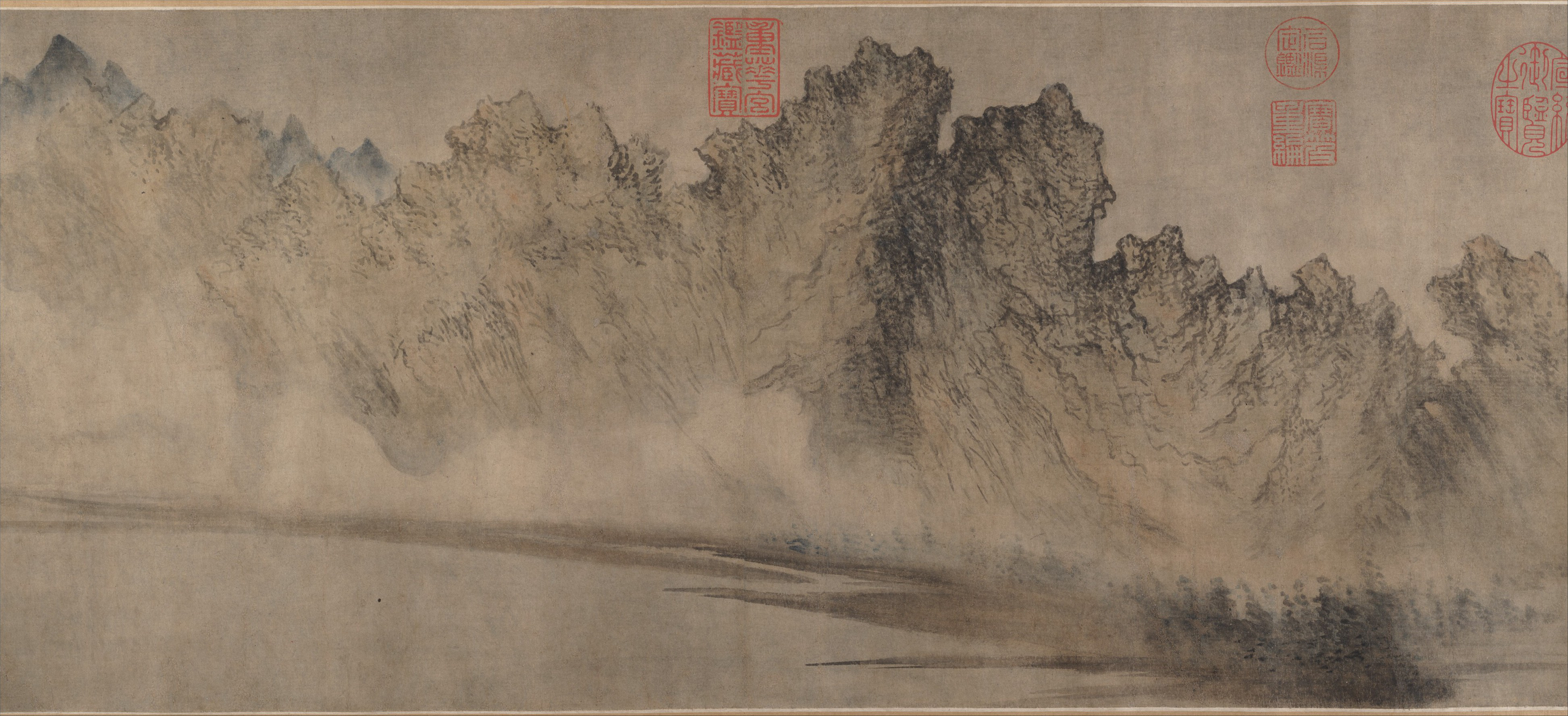
There remains, as always, the mountain and its silence. On Fang Congyi’s silk, the peaks sink into mist and no path leads anywhere; there is nothing to do there, nothing to extract, and that is why we return. The great tree, too, still stands by the road, eight thousand seasons old, good for nothing—unless to cast shade for one who never thought to cut it down.
Sources cited
- Aristote, Morale à Nicomaque (Éthique à Nicomaque), Livre X, ed. Germer-Baillière, 1856 (Wikisource), trans. Jules Barthélemy-Saint-Hilaire.
- Tchouang-Tseu, Œuvre de Tchoang-tzeu (ch. I « Pérégrination », IV « Le monde des hommes », XX « La montagne »), ed. Les Pères du système taoïste, 1913 (Wikisource), trans. Léon Wieger.