The Duck and the Heron
Zhuangzi, Spinoza, and Marcus Aurelius on the nature proper to beings—and the temptation to tailor them to an end that is not their own.
A duck has short legs, a heron long ones. One may find the first too low, the second too lofty, and dream of correcting the imbalance—lengthening the duck a little, shortening the heron a little, to bring them to a common measure that is, we believe, the right one. The image is ancient, from a Chinese book of the fourth century BCE, and it carries the quiet simplicity of things that need no proof: hearing it, one senses that such an act would be cruel. But why, exactly? What makes the duck’s short leg right, and its lengthening wrong?
The question is not quaint. It resurfaces, intact, every time a hand proposes to amend a living thing—to make it more useful, more productive, more conformable to a use already fixed for it. Behind the gesture lies the same unspoken conviction: that a being’s measure comes from without, from the end assigned to it, not from what it is in itself. Three thinkers who never met oppose this conviction—a Taoist, a seventeenth-century Dutch philosopher, a Roman emperor. They do not say the same thing; that is why it is worth listening to each in turn. But all three hold that a being carries its measure within itself, and to remove it is to destroy the being while believing one improves it.
I. Zhuangzi: Not Violating Nature
Zhuangzi reasons through the body. Before speaking of the soul, of mores, of government, he observes a membrane between toes, an extra finger, and draws a distinction that will govern all the rest: there is what comes from the body and what is conformable to it. A growth comes from the body, yet is unnatural, because it exceeds what was meant to be. Nature is not everything that grows; it is the right proportion of what grows. Hence the rule, stated with a gentleness that belies its reach:
Do not violate nature, even under the pretext of correcting it. Let the composite remain composite, and the simple simple. Let the long remain long, and the short short. Refrain from lengthening the duck’s legs or shortening the heron’s. To attempt it would cause them suffering, which is the hallmark of all that is against nature, while pleasure is the mark of the natural.
The criterion is striking: it is not a law, but suffering and pleasure. What contradicts a being’s nature hurts it; what aligns with it delights it. Proper nature needs no proof; it signals itself from within, through the well-being of those who follow it and the pain of those who force it. And “correcting” is the treacherous word: one never mutilates a being out of caprice, always in the name of a correction, a betterment, a higher norm. It is precisely this pretext that Zhuangzi rejects—not because all improvement is vain, but because the measure invoked to correct is foreign to the being it claims to straighten.
The next chapter shifts the image from bird to horse, from anatomy to training. Here, it is no longer a deformity one heals, but a beast one civilizes—and the trainer boasts of it as a benefit.
Horses naturally have hooves fit to tread snow, and coats impervious to the wind. They graze on grass, drink water, run and leap. That is their true nature. They have no need of palaces or stables. […] When Pai-lao, the first groom, declared that he alone knew how to treat horses; when he taught men to brand, shear, shoe, bridle, hobble, and pen these poor beasts, then two or three out of ten horses died prematurely, from the violence done to their nature.
The irony is exact and spares nothing: the man who claims to “know” horses is the one who kills them. Skill here is unmaking. And Zhuangzi does not stop at the beast: in the same breath, he names the potter who “knows” clay and the carpenter who “knows” wood—both imposing on the material shapes—round, square, straight—that are not its own. Each time, the same pattern: an expert appears, decrees an external end (to serve, to bear, to contain), and the thing, to comply, must lose what it was. The verdict falls, without appeal or anger: This man is guilty of the crime of perverting horses.
It would be wrong to read this as a mere celebration of wildness. What Zhuangzi targets is not civilization itself, but the imposed finality—the idea that a being exists for something that is not itself, and that one therefore has the right to tailor it to that use. His response is not a program, but a letting-go: let the long be long. Like water that disputes nothing and flows where none would go, the Taoist sage adds no constraint to the course of beings; he lets them unfold according to a norm that is interior to them, and which the trainer, for his part, never sees, because he looks at his end, not the beast.
II. Spinoza: The Essence That Strives
Let us change century and language. Spinoza speaks neither of ducks nor horses to sentimentalize; he constructs a geometry of being. And yet, at the heart of this geometry, he posits a proposition that says, in another grammar, the same intuition as the Chinese—that each thing carries within itself the principle of what it is:
Each thing, as far as it can by its own power, strives to persevere in its being. […] The effort by which each thing strives to persevere in its being is nothing but the actual essence of the thing.
The consequence is immense. If the essence of a thing is nothing other than its effort to persevere in its being, then to change a being’s nature is not to improve it: it is to suppress it. There is no neutral ground that remains, beneath transformations, identical to itself; the ground is the tendency, and to alter the tendency is to annihilate the ground. Spinoza says it with an example that would have made Zhuangzi smile in recognition—for he, too, chose the horse:
A horse, for example, is destroyed as much if it is turned into a man as if it is turned into an insect.
The sentence is precious in its coldness. To become a man would not be, for a horse, a promotion: it would be its death, just as becoming an insect would be. There exists no universal scale at whose summit man presides, toward which all else would do well to strive. The perfection of a horse is to be fully horse; its power to act is measured only by the standard of its nature, not ours. Spinoza carries the observation into the most intimate of appetites: “The horse and man are doubtless driven by the Lust to procreate; but the former by a horse’s Lust, the latter by a man’s.” Even the most common desire unfolds according to each one’s essence; and the flourishing of one, he writes, differs from that of the other “as much as the nature or essence of one differs from the nature or essence of the other.”
This seems to align exactly with Zhuangzi. But let us distinguish, for the two do not walk in step. For Zhuangzi, wisdom is to leave nature alone: the right gesture is withdrawal, abstention, almost silence—do not shoe, do not bridle, do not hew. For Spinoza, essence is not a rest to be preserved, but a thrust to be deployed. The conatus is not the innocence before effort; it is the effort; to persevere in one’s being is not to remain still, but to increase one’s power to act according to the laws of one’s own nature. The Chinese bids us not to cut; the Dutchman, not to hinder the unfolding. One defends the duck against the surgeon; the other defends the horse’s strength against all that would diminish it. Letting-be is not quite the same as letting-grow. And it is a real difference: one does not protect a being in the same way when one thinks of it as a form to be respected and when one thinks of it as a power to be freed.
III. Marcus Aurelius: Following Nature—But Which One?
The Stoic complicates everything, and that is his role here. For Marcus Aurelius, too, would make his own the phrase: follow nature. It is even the heart of his morality. But beneath the same words lies a thought almost opposite, and one must face it without reducing it to the first two.
Tell yourself again that every being naturally moves toward the thing for which its organization was made; and that the thing toward which it moves in this way is precisely its end and purpose. […] Is it not equally evident that the less good are made for the better, as the better are made for one another? Now, animate beings are better than inanimate ones; and rational beings are better than merely animate ones.
Everything is said in a phrase neither Zhuangzi nor Spinoza would have signed: the thing for which its organization was made. For the Stoic, each being does have a nature—but this nature is a function within an order, and this order is hierarchical. There is a high and a low, beings made for others, a finality not suspect but providential. Where Zhuangzi saw in imposed finality the very crime, Marcus Aurelius reads the rational structure of the world: if animate beings are better than inanimate ones, and rational ones better than animate, then it is conformable to nature that the former serve the latter. The same phrase—follow nature—permits in one what it forbids in the other.
It would be easy, and false, to make the Stoic the poor student of the lesson. His position is coherent and elevated: he does not mutilate any being out of caprice, he inscribes it in a harmony that surpasses it and gives it meaning. The Stoic horse is not a slave, but a member—as the hand and foot are members of the same body, and contribute to a common work. Nature, for Marcus Aurelius, is not a collection of individuals to be left in peace, each in its corner; it is a single immense living thing of which each being is a part, and where the inferior part finds its dignity in serving the whole. It is a grandeur—and it is exactly what the other two reject. For Zhuangzi, as soon as a being is “made for” another, violence has begun. For Spinoza, there is no hierarchy of essences: the horse is not “less good” than man, it is differently perfect, and the very idea of an order where some are for others belongs to that finalist illusion he spent his life dissolving.
Synthesis: Three Ways of Holding to Measure
Three times proper nature, and three times something else. For Zhuangzi, a being’s measure is a form not to be touched: the short leg is right because it is its own, and wisdom is the abstention of one who effaces himself before what suffices. For Spinoza, measure is a power not to be diminished: essence is an effort, and to respect it is to let a being grow according to its law, not to immobilize it. For Marcus Aurelius, measure is a function to be honored: each nature has its place in an order, and to follow it is to hold one’s rank in a whole that has meaning. Letting, deploying, ordering: three grammars of the same respect, which it would be lazy to merge into a vague “wisdom of the natural.”
And yet—here, after distinguishing, one may, without cheating, bring them closer—the three stand against a single adversary. This adversary is not transformation, but the foreign measure: the pretension to evaluate a being by the standard of an end that is not its own, and to remake it so that it may better answer to it. The duck judged too low, the horse judged too free, the thing judged too little useful—always the same gesture, which takes an external end for the truth of the being and calls “improvement” what is, measured from within, an amputation. Zhuangzi opposes the suffering of the forced beast; Spinoza, the destruction of the altered essence; Marcus Aurelius himself, whose order seemed to permit everything, opposes the demand that each being be moved toward what it is made for—not toward what our convenience would have it be. Even the finalist recoils from the end being ours rather than the thing’s.
That three such distant thoughts—one that falls silent before nature, another that calculates it, a third that hierarchizes it—converge on this point should give pause to anyone who today holds a hand over the living. They do not describe another world; they name in advance the question posed by every power to reshape beings: to which measure does it answer? Theirs, or ours? And if ours, by what right does it call correction what is only an end substituted for another?
Closing
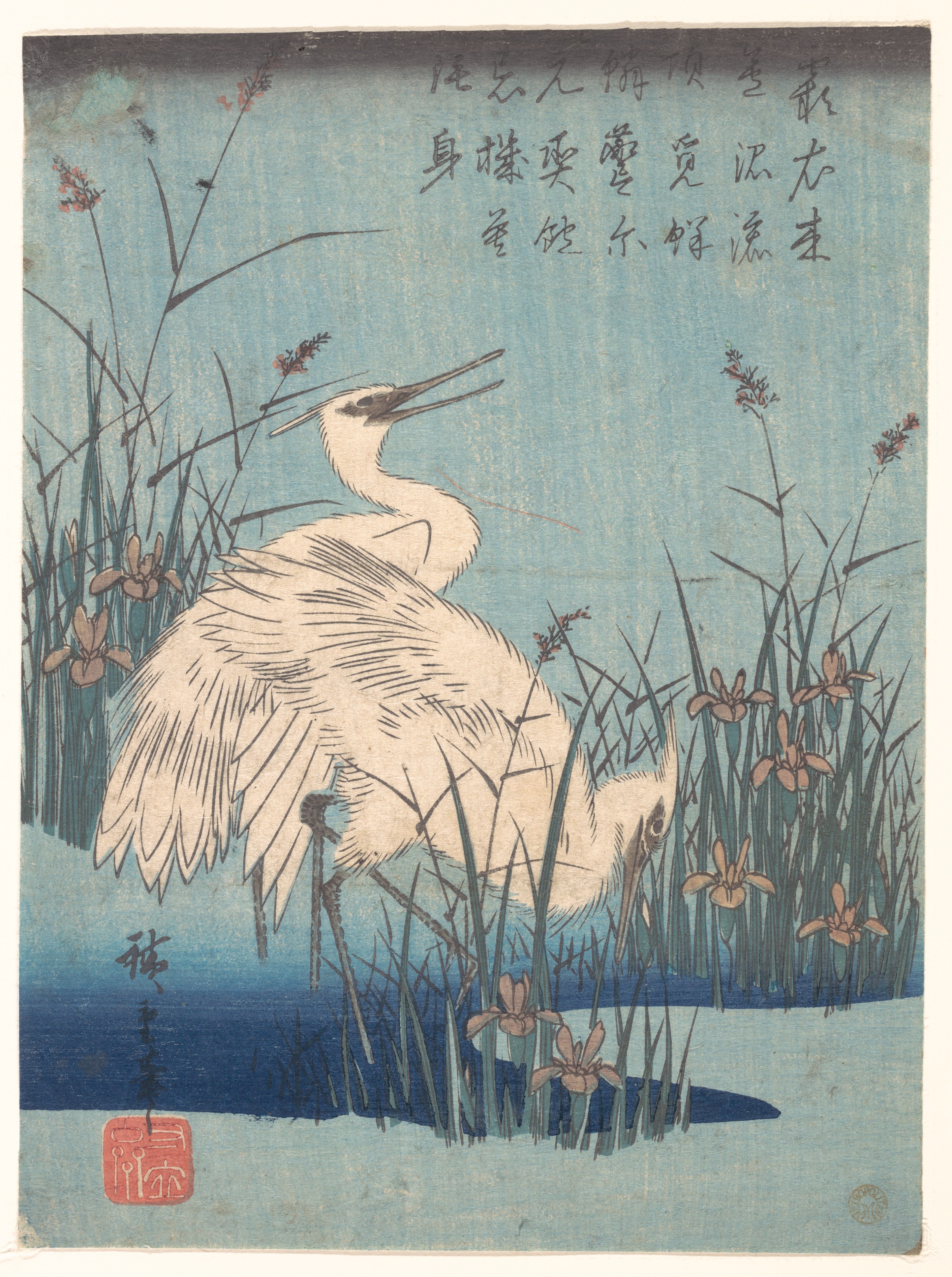
On Hiroshige’s print, an egret stands among the irises, motionless, in the shallow water. Its legs are long—absurdly long, someone might say who would have all things at the same height. But it is by these legs that it enters the water without wetting its body, that it waits, that it fishes, that it is what it is. To shorten them would be to drown it.
There is, in this patience of the bird, no lesson to receive and no one to correct. There is only a form accomplished, which asks nothing, and which stands there like a question posed to the passerby: are we still capable of looking at a being without already calculating what it might become in our hands? The long is long. The heron knows it without knowing. It remains for us to learn it, or to learn it again.
Sources cited
- Tchouang-Tseu, Œuvre de Tchoang-tzeu (ch. VIII « Pieds palmés », IX « Chevaux dressés »), ed. Les Pères du système taoïste, 1913 (Wikisource), trans. Léon Wieger.
- Baruch Spinoza, Éthique (III, prop. 6-7 ; III, scolie prop. 57 ; IV, préface), ed. Wikisource (trad. Appuhn, 1913), trans. Charles Appuhn.
- Marc Aurèle, Pensées pour moi-même (Livre V), ed. Germer-Baillière, 1876 (Wikisource), trans. Jules Barthélemy-Saint-Hilaire.