What Depends on Us
Epictetus, a slave, divides the world in two. Zhuangzi asks who draws the line.
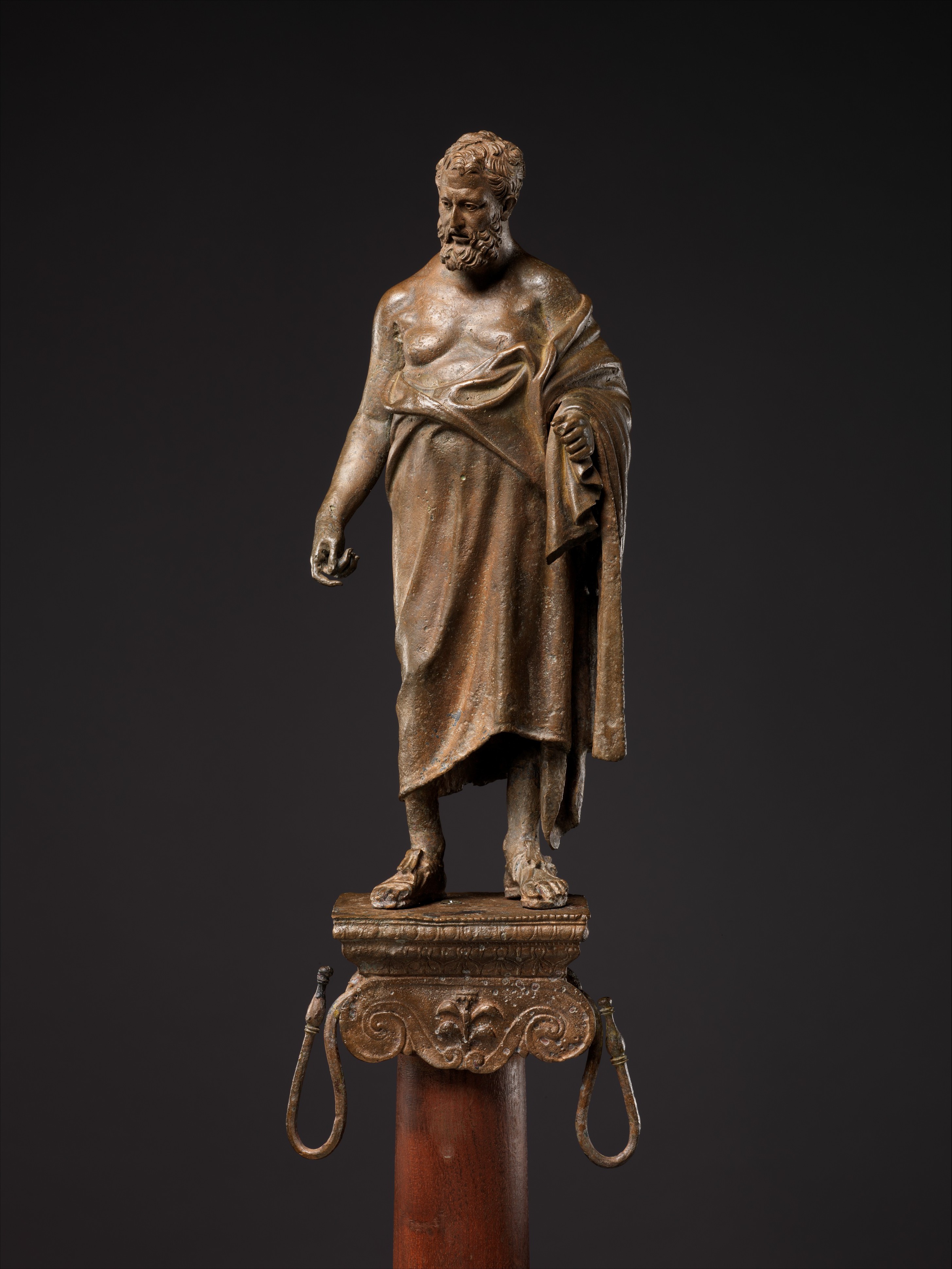
 A slave in the household of one of Nero’s freedmen, Epictetus had his leg broken by a master who took pleasure in twisting it. He warned Epaphroditus, without raising his voice: “You’re going to break it.” The master persisted, the bone snapped, and the lame man added: “I told you so.” This was the man—without a body to call his own, without a name, without the right to go where he pleased—who bequeathed antiquity’s sharpest words on what, within us, cannot be taken away.
Among things, some depend on us, others do not. Those that depend on us are opinion, choice, desire, aversion—in a word, whatever is our own doing. Those that do not depend on us are the body, possessions, reputation, status—in a word, whatever is not our own doing.
His entire Stoicism rests on this division. On one side, what is our doing: judgment, desire, refusal. On the other, what is not: the body, fortune, reputation, honors—and, for one who speaks from experience, even the condition of slave or free man. The summary is too hasty: the line would separate inner from outer. It does not run there. It runs between what answers to our assent and what, no matter what, will never depend on it.
The lesson first appears as a hygiene of the mind: cling only to what you control, and nothing can touch you. Confuse the two columns, “believe free what is by nature enslaved,” and you become “shackled, distressed, troubled.” Order them correctly, and you become unassailable. But to reduce the Handbook to a sedative is to dull its edge. For this is not written by a sage at ease. It is written by a man from whom everything has been taken, who seeks what remains when nothing remains.
A Slave’s Consolation?
When his master threatens, Epictetus does not bend his reasoning to servitude—he turns it against servitude itself.
But I will chain you. — Man, what are you saying? Chain me? You may chain my leg, but my faculty of judgment and choice—even Jupiter himself cannot overcome it.
The same sentence can be heard in two opposing ways, and that is the whole point. One might read: since the chain does not depend on you, cease to care about it—and the doctrine becomes an anesthetic, the consent of the dominated to their domination, the wisdom a master would have an interest in teaching his servants. One might also read: what no master has ever given you, no master can take away—and the same sentence becomes the rock on which a man without rights stands firm. Epictetus does not choose for us. He merely establishes that the shackling of the body and the servitude of judgment are two different things, and to confuse them is to invite misfortune. This is not an invitation to resignation; it is the refusal to surrender the only ground that cannot be surrendered. The same steadfastness would nourish, two generations later, the inner citadel of an emperor—proof that the doctrine does not console a condition, but cuts across them all.
Yet one question Epictetus does not ask: his boundary assumes a stable self, fortified, indestructible—the will as a citadel no one can breach. What if this inner realm were not so firm?
The Butterfly’s Doubt
At the other end of the ancient world, a Taoist asks precisely this question. Zhuangzi does not divide the world into two columns; he dissolves the one that separates the self from everything else.
Once, Zhuangzi dreamed he was a butterfly, fluttering content with its lot. Then he awoke, and there he was, Zhuang Zhou. Who am I, really? A butterfly dreaming it is Zhuang Zhou, or Zhuang Zhou imagining he was once a butterfly?
We must resist the temptation to reconcile them with a word. They do not say the same thing. Epictetus builds; Zhuangzi dissolves. For the Stoic, freedom lies in a faculty no torture can reach: it requires a subject, and a subject hard as diamond. For the Taoist, this subject is already a dream among others, a fleeting form in the flux of transformations—and to demand that it keep its gates closed is still a clenching, a way of gripping. Where Epictetus clenches his fist around what depends on him, Zhuangzi opens his hand and lets himself change into a butterfly.
The Stoic would reply without difficulty: doubt the butterfly all you like, it is still you who doubts, and no one can wrest that doubt from you. The Taoist would smile: you call a citadel what is only a knot, and you call freedom the effort not to untie it. Neither is wrong in his own tongue. They simply do not draw the line in the same place—one between what depends on me and what does not, the other between the illusion of a self and the great passage that carries it away.
But the slave had no leisure to dream he was a butterfly. His leg was being twisted. Facing the instrument of torture, his words—“I told you so”—are not a thesis on identity: they are what a man opposes, bare-handed, to what seeks to reduce him. Epictetus’s boundary is narrow. Perhaps that is why it holds.
Sources cited
- Épictète, Manuel, ed. Librairie Ch. Delagrave, 1875, trans. Jean-Marie Guyau.
- Épictète, Entretiens (extraits), ed. Librairie Ch. Delagrave, 1875, trans. Jean-Marie Guyau.
- Tchouang-Tseu, Œuvre de Tchoang-tzeu, ed. Les Pères du système taoïste, 1913, trans. Léon Wieger.