The Limit as Condition of Freedom
Three Voices on an Aporia: Transcend, Deconstruct, Respect
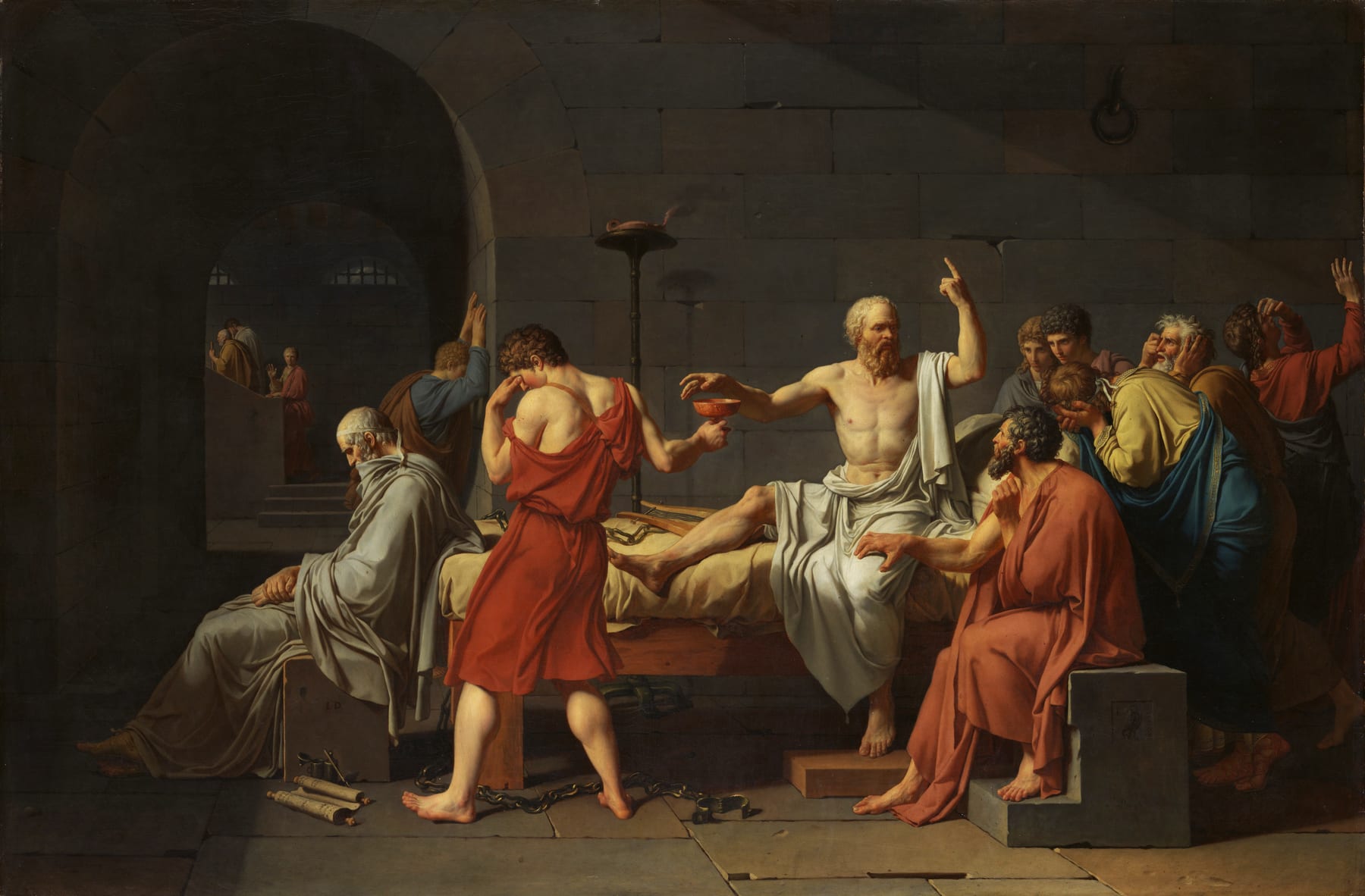
In the space where propositions intersect, the limit is never a mere edge. It is what, in rising, reveals the very nature of what it bounds. Three thinkers have grasped it from angles so opposed they seem irreconcilable: for one, it is a metaphysical prison whose key lies in understanding; for another, a social fiction to be pierced by laughter and gesture; for the last, a natural law to be honored as the foundation of all existence. These divergences are not errors, but angles of attack on the same enigma: how can freedom arise from what restricts it? The answer, if answer there be, lies neither in synthesis nor in choice, but in the rigorous examination of what each voice proposes—and what it leaves unsaid.
The Limit as Necessity to Understand: Spinoza
Spinoza does not speak of limits, but of causes. Freedom, for him, is not exemption, but comprehension. What appears to bound man—passions, laws, determinisms—is in reality only a veil cast over the necessary order of things. The limit is not an obstacle, but a structure of reality itself, and it is by understanding it that one accesses the power to act.
On the Power of the Understanding, or Human Freedom. – BY CAUSE OF ITSELF I UNDERSTAND THAT WHOSE ESSENCE ENVELOPS EXISTENCE, OR THAT WHOSE NATURE CANNOT BE CONCEIVED EXCEPT AS EXISTING.
The formula is dense, almost opaque. “Cause of itself”: that which exists by the sole necessity of its nature, without depending on another. God, or Nature, is this substance whose essence envelops existence—that is, whose being cannot be thought without its being. For man, to be free does not mean escaping this necessity, but recognizing it. The limit is not what opposes freedom, but what makes it possible as understood freedom.
Spinoza does not deny constraints. He displaces them: what appears external (laws, passions, social structures) is in reality an expression of the same necessity that governs all things. Freedom is not in transgression, but in adequation. To understand a limit is to cease suffering it and to make it a lever. The glutton’s house, for Diogenes, is a prison of filth; for Spinoza, it would be a system of causes to unravel. Vomiting is not liberation, but a symptom—and it is by tracing back to the cause (gluttony, property, the illusion of mastery) that one accesses a higher freedom: that of the understanding which sees the order of things and inserts itself without resistance.
The limit, here, is not to be crossed, but thought. It is not a wall, but an equation. Spinozist freedom is not the absence of constraints, but their integration into a system where all is linked. What seems to bound is in reality what constitutes: the limit is the very condition of power, provided one grasps it as necessary.
The Limit as Illusion to Dissolve: Diogenes of Sinope
Diogenes does not theorize. He acts, he laughs, he shows. The limit, for him, is not a metaphysical structure, but a social construct, a fiction maintained by habit and cowardice. It is not to be understood, but dismantled—not by reason, but by gesture, word, body.
Noticing that a glutton’s house was for sale, he remarked: “I knew it—stuffed as it is with filth, it was bound to vomit up its master.”
The scene is small, but it contains an entire philosophy. The glutton’s house is not merely a dwelling: it is a symbol. It is “stuffed with filth”—not with food, but with what corrupts, what imprisons. The glutton is not just a man who eats too much; he is a man who has let himself be defined by his possessions, his excesses, his illusions. The limit, here, is not a natural law, but an invention: that of property, respectability, shame.
Diogenes does not seek to understand this limit. He denounces it. The vomiting he predicts is not a medical metaphor, but an image of truth: what has been ingested (wealth, power, conventions) must be rejected. Freedom, for him, is not in adequation to an order, but in rupture. The social limit is not a necessity, but an imposture—and it is by piercing it, ridiculing it, living it as absurd that one accesses a more radical freedom: that of the cynic who has nothing left to lose because he has rejected everything.
Spinoza sees the limit as a structure to integrate; Diogenes sees it as a fiction to destroy. For one, freedom lies in understanding; for the other, in subversion. The glutton’s house, for Spinoza, would be a system of causes to analyze; for Diogenes, it is a theater of the absurd, a place where truth reveals itself through laughter and disgust. The limit is not a given, but a construct—and it is by deconstructing it that one accesses a freedom no longer that of the understanding, but that of pure gesture.
The Limit as Boundary to Sanctify: Aldo Leopold
Leopold does not speak of freedom, but of community. The limit, for him, is neither a metaphysical necessity nor a social illusion, but an ecological reality—a boundary that both separates and connects. It is not to be understood or deconstructed, but respected, for it is within it that the very balance of the living is at stake.
In Europe, where forestry is ecologically more advanced, non-commercial species are recognized as members of the native forest community and preserved as such to the extent possible.
The sentence is technical, almost administrative, but it carries a worldview. The forest is not a reservoir of resources, but a community—an assemblage of beings linked by complex relations, where each species, even the “non-commercial,” has its place. The limit, here, is not a constraint, but a condition of possibility. Preserving unprofitable species is to recognize that the forest exists only in the balance of its parts—and that this balance is itself a limit: the threshold beyond which the community unravels.
For Spinoza, the limit is a necessity to understand; for Diogenes, an illusion to dissolve. For Leopold, it is a law—not a human law, but an ecological one, as imperious as gravity. Freedom, in this perspective, is not in transgression or understanding, but in respect. To respect the limit is to recognize that man is not a master, but a member among others of the biotic community. Freedom is not the absence of constraints, but the capacity to live with them—to integrate them as conditions of existence itself.
The glutton’s house, for Leopold, would be a metaphor for exploitation: a place where one takes without giving back, where natural limits are ignored. Diogenes’ vomiting would, here, be an image of ecological rupture—the moment when the system rejects what it can no longer assimilate. But Leopold does not laugh. He observes, measures, proposes another path: that of a forestry that does not deny the limit, but recognizes it as foundation. Freedom, in this view, is not in domination, but in belonging.
The Common Summit: Three Limits for a Single Enigma
The three propositions seem irreducible. For Spinoza, the limit is a structure to understand; for Diogenes, a fiction to destroy; for Leopold, a boundary to respect. Yet they share a common intuition: freedom is not in the absence of limits, but in their articulation.
Spinoza proposes integrating them through reason. The limit is not an obstacle, but a given of reality—and it is by understanding it that one accesses a higher freedom. Diogenes proposes piercing them through gesture. The limit is not a necessity, but a construct—and it is by deconstructing it that one accesses a more radical freedom. Leopold proposes sanctifying them. The limit is not an illusion, but a law—and it is by respecting it that one accesses a deeper freedom.
None of the three denies the limit. All displace it: one toward necessity, another toward illusion, the last toward law. But in this very displacement, a question persists: what if freedom were not the absence of limits, but their right measure? Neither blind submission, nor pure rejection, nor cold understanding, but their recognition as what, in bounding, makes possible.
The glutton’s house, for Spinoza, is a system to analyze; for Diogenes, a theater to ridicule; for Leopold, an ecosystem to preserve. Three gazes on the same object—three ways of saying that the limit is not a wall, but a threshold. And that it is by crossing it, or respecting it, or understanding it, that one accesses what may, perhaps, be freedom.
Sources cited
- Baruch Spinoza, ethique, ed. Wikisource (trad. Charles Appuhn, 1913), trans. Charles Appuhn.
- Diogène de Sinope, Vies, doctrines et sentences des philosophes illustres — Livre VI, Diogène, ed. , trans. Jacques-Georges Chauffepié (1758).
- Aldo Leopold, Almanach d un comt des sables, ed. .